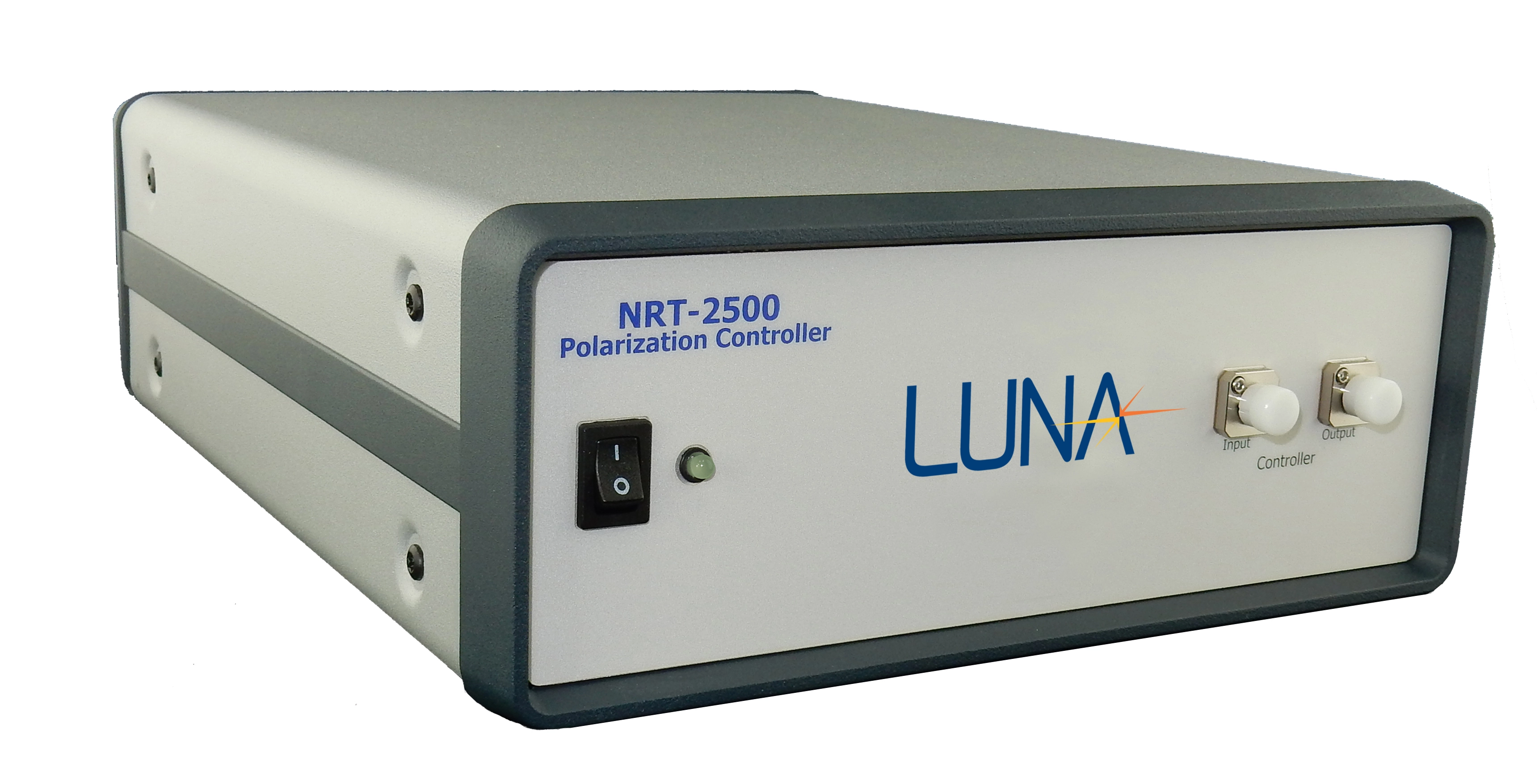
Luna NRT-2500 Polarization Control Platform with Tracker, Scrambler, Spinner and Depolarizer Modes
Benchtop LiNbO3 polarization control platform with seven built-in functions, including tracking, scrambling, spinning and depolarizing.
- Insertion loss
- < 3 dB
- PDL
- < 0.3 dB
- Optical return loss
- > 50 dB
- Optical power handling
- < 20 dBm
Overview
The Luna NRT-2500 is a benchtop polarization control platform. It provides several built-in polarization control functions for developing and manufacturing optical transponders, devices and sub-systems. Luna has discontinued the product and lists the MPC-201 Multifunction Polarization Controller and the POS-203 Polarization Stabilizer as alternatives.
The instrument pairs an integrated-optic lithium niobate (LiNbO3) waveguide polarization controller, which responds very quickly, with digital signal processors (DSPs) and field programmable gate arrays (FPGAs) that the user can customize. This combination lets one unit run seven polarization functions: Acquirer, Depolarizer, Paddles, Randomizer, Scrambler, Spinner and Tracker.
Architecture
High-slew-rate voltage amplifiers drive the LiNbO3 polarization control device. A DSP runs the tracking algorithm and the other polarization control processes, and the FPGA and communications are isolated from the DSP. Analog-to-digital converters on four rear-panel BNC inputs accept external signals for control and feedback. The tracking error function (TEF) combines these inputs into a single feedback signal for the Tracker and Acquirer modes.
Control and automation
The unit connects to a PC over RS-232 or Ethernet and is operated through a Windows GUI. The GUI includes a built-in tracking optimizer that tunes the tracking algorithm parameters. All modes can also be automated with SCPI commands, and a DLL driver is available for C, C++, LabVIEW, LabWindows/CVI, Visual C++ and Visual Basic. A rear-panel Link I/O port supports master/slave operation of two units.
The NRT-2500 was originally developed by New Ridge Technologies, which was acquired by Luna Innovations.
Key Features
- Paddles mode: full polarization control by rotating any of 5 electro-optic ¼-wave plates to set the SOP
- Scrambler mode: uniform polarization scrambling with full Poincaré sphere coverage and user-selectable Rayleigh-distributed scrambling rates
- Depolarizer mode: single-speed, ultrafast random scrambling to reduce the degree of polarization (DOP) of the measured signal
- Spinner mode: SOP rotations up to 940,000 rad/sec for characterizing coherent PM-QPSK transceivers
- Tracker mode: fast, robust and endless polarization tracking without dropouts
- Acquirer mode: automated paddles that drive the SOP to maximize or minimize a feedback signal
- Randomizer mode: ultrafast SOP impulse events to imitate lightning-induced dSOP/dt events
- Integrated-optic LiNbO3 waveguide polarization controller driven by customizable DSPs/FPGAs
- Four ADC (BNC) inputs for external feedback and trigger signals
- Built-in tracking optimizer in the GUI
- SCPI automation via RS-232 or Ethernet
- Link I/O for master/slave operation of two units
Specifications
| Insertion loss | < 3 dB |
|---|---|
| PDL | < 0.3 dB |
| Optical return loss | > 50 dB |
| Optical power handling |
< 20 dBm
Luna-branded datasheet prints "< 20 dB"
|
| Operating wavelength |
1.55 microns (C- and L-bands)
Luna-branded datasheet also lists 1.31 and 1.064 micron windows
|
| Additional wavelength windows |
1.31 and 1.064 micron windows
Listed only in the Luna-branded datasheet
|
| Optical connectors | FC/UPC, FC/APC, SC |
| Scrambler mode SOP speed |
up to 3,400 rad/sec for rmode ≡ b0.5 of a Rayleigh distribution
rmode is the statistical mode of the distribution, ⟨r⟩ is the mean SOP change; 99.9% of all SOP changes occur before rmax = 3⟨r⟩ ~ 3.76rmode
|
|---|---|
| Scrambling mode (SOP speed distribution) parameters |
rmode≡b0.5 < 3,400 radians/second, with <r> ≡1.25 rmode, rmax~3.76 rmode
For a Rayleigh distribution
|
| Spinner mode rate | 940,000 rad/sec on great circle orientation for 75 kHz drive |
| Enhanced spinner mode rate | 75kHz (or >470,000 rad/sec for SOP aligned in S1-S2 plane) |
| Spinner frequency range | 0 to 75,000 Hz |
| Randomizer mode SOP speed |
up to 2,250,000 rad/sec
Calculated assuming π radians on Poincaré sphere in 1.4 µs
|
| Randomizer dwell time (internal trigger) |
200 and 32,000,000 microseconds
Range of the time between SOP changes
|
| SOP slew speed |
~1.4 microseconds (up to 1,500,000 rad/sec)
For π/2 radian SOP transitions in 1μs
|
| Depolarizer mode SOP speed |
over 3,000,000 rad/sec
Non-stochastic dSOP/dt distribution from 0 to >3 Mrad/sec completely covering Poincaré sphere
|
| Tracker mode update time |
~20 microseconds
Closed-loop feedback/update algorithm loop time; feedback signal detector response time and algorithm customization may slow system response
|
| Paddle mode wave-plate configuration | ¼-¼-½-¼-¼ wave-plate configuration |
| Communication interfaces |
RS-232
RS-232-to-USB dongle provided with each NRT-2500; the web page and user manual also list Ethernet
|
|---|---|
| Communication interface (web page) | Ethernet, RS-232 |
| Analog inputs |
4 ADC (BNC) inputs
Rear panel
|
| Additional rear-panel connections | Link I/O (for the master/slave operation of 2 NRT-2500 units or for digital interface); DAC outputs (optional configuration) |
| Serial setup | Baud Rate: 115200, Parity: None, Data Bit: 8, Stop Bit: 1 |
| Remote control | SCPI commands via RS-232 or Ethernet |
| Power supply | 12 VDC from 100-240 VAC, 50 – 60 Hz, AC-DC converter |
| Dimensions | H=4.04” (102.6 mm), W=10.12” (257 mm), D=12.32” (313mm) |
|---|
Specifications are taken from the manufacturer's documentation. See the datasheet for complete and current values.
Applications
- General lab use
- Coherent receiver and DSP testing
- PLD and Si-photonic device testing
- Testing lightning effects on coherent communication systems
- Directed energy, coherent beam combination and LIDAR system prototyping
- Fiber loop testing
- Optical transponder, device and sub-system development and manufacturing
Included
- RS-232-to-USB dongle
- NRT-2500 software CD
Documents & Resources
Related Products
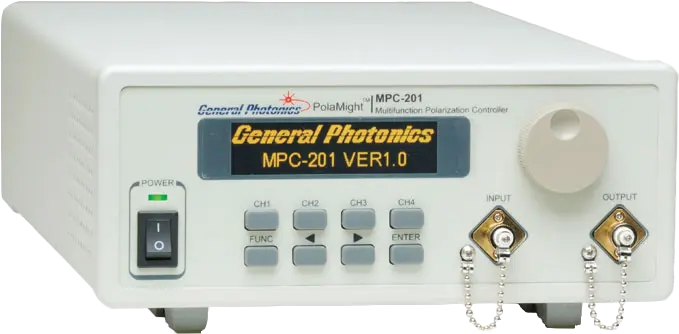
All-fiber multifunction polarization controller with manual control, variable-rate scrambling, SOP modulation and triggered random SOP generation.
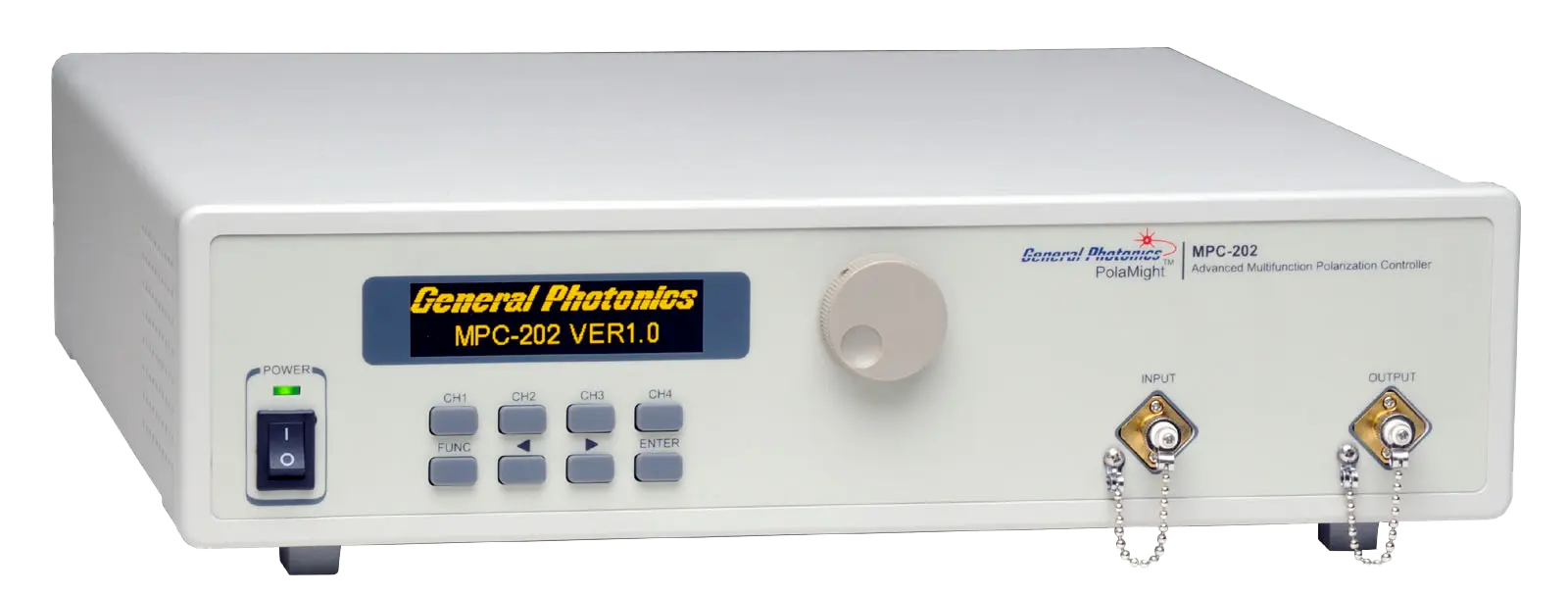
Multifunction polarization controller with high-speed Tornado scrambling and square-wave SOP transitions for coherent receiver stress testing.
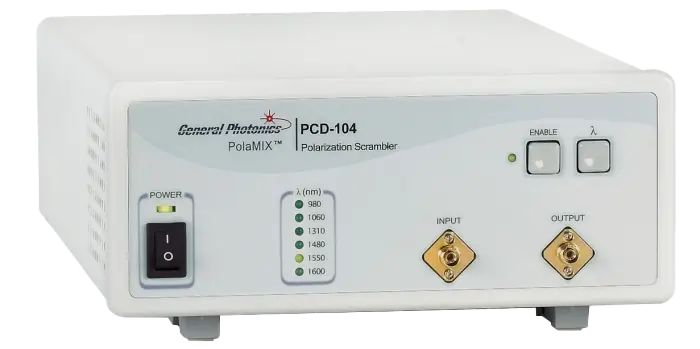
Benchtop all-fiber polarization scrambler that gives uniform Poincaré sphere coverage, with output DOP below 5% when averaged over 2 ms.
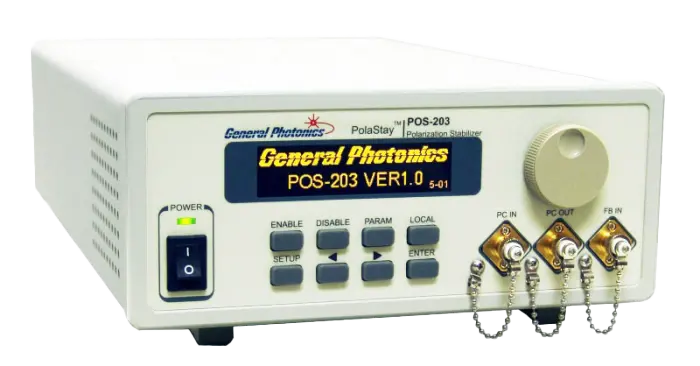
Polarization stabilizer that holds a stable output SOP by maximizing or minimizing an optical or electrical feedback signal, with reset-free tracking.
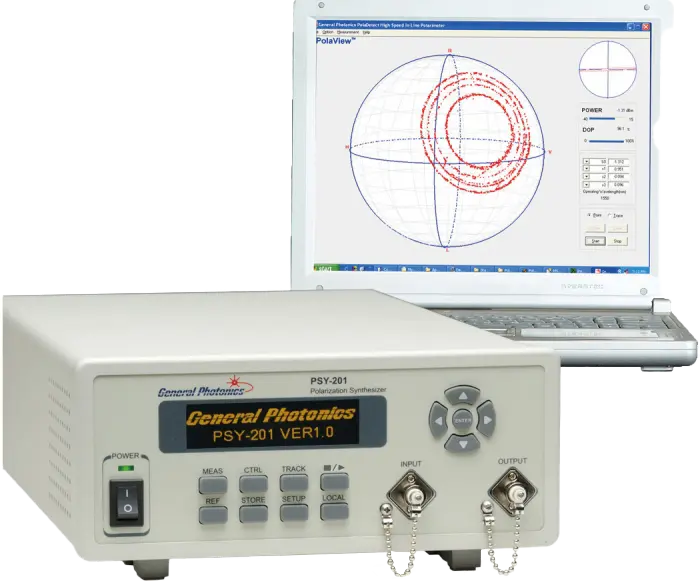
Deterministic polarization controller and polarimeter that generates, maintains, scrambles and analyzes any state of polarization regardless of input SOP.