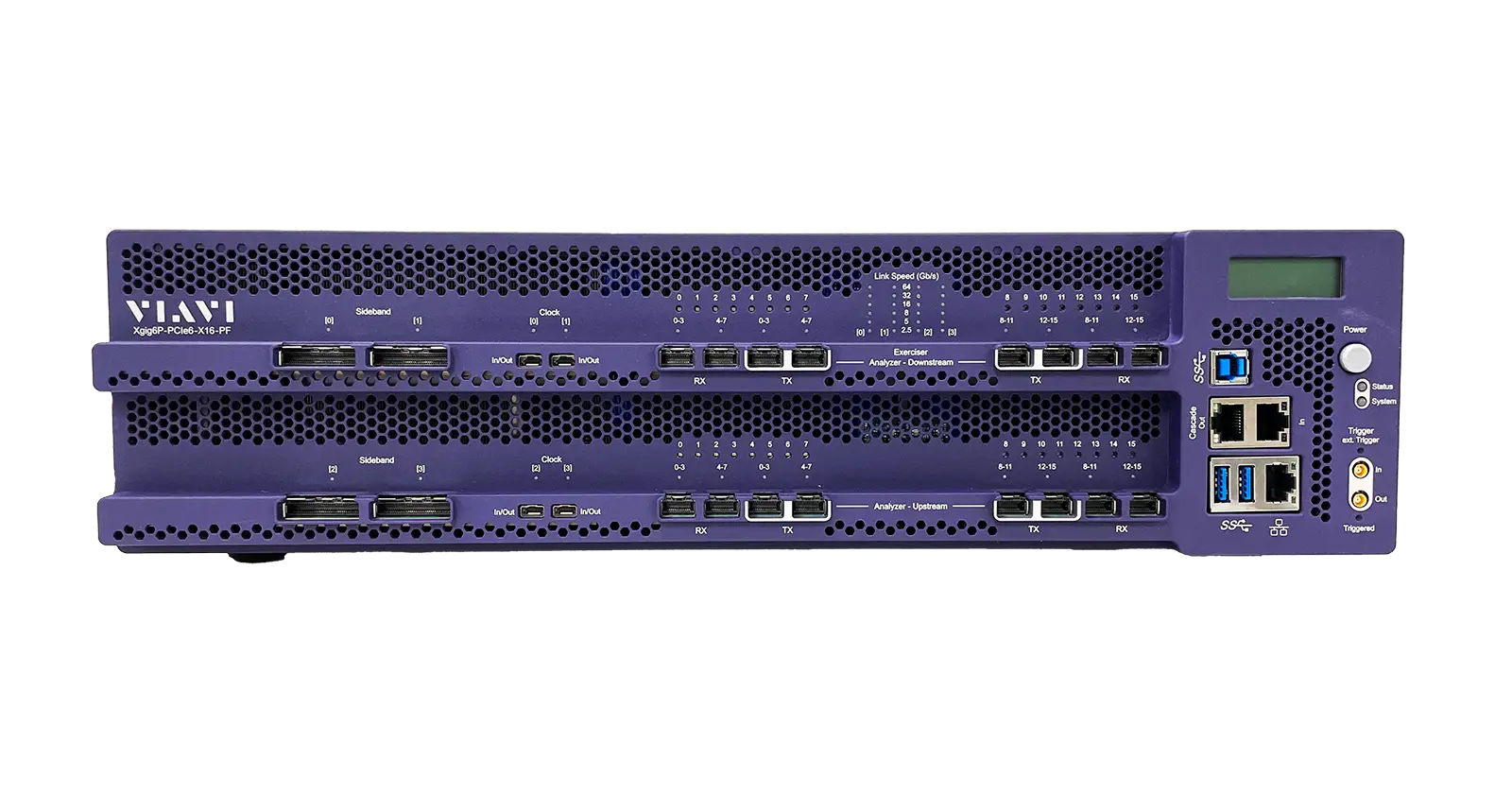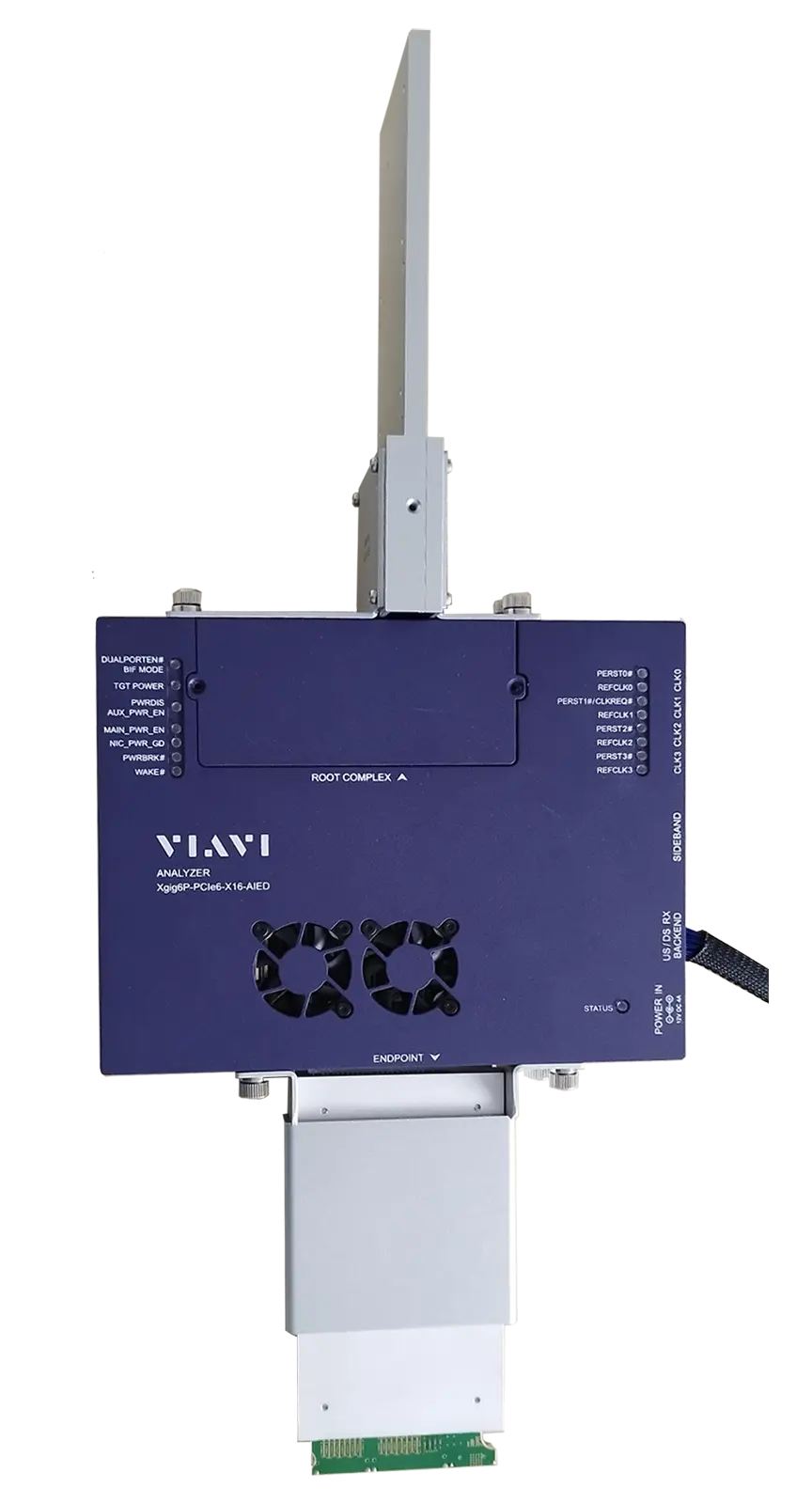
Xgig XGIG6P-PCIE-X16-IOCP3 PCIe 6.0 x16 Analyzer/Exerciser Front End for OCP NIC 3.0
PCIe 6.0 x16 Analyzer/Exerciser front end attachment for OCP NIC 3.0 modules, part of the Xgig EDSFF Analyzer Interposer family for 64GT/s capture.
- Form factor
- OCP NIC 3.0 (OCP3)
- Lane width
- x16
- PCIe generation
- PCIe 6.0
- Data rate
- 64GT/s
Overview
The XGIG6P-PCIE-X16-IOCP3 is the PCIe 6.0 x16 Analyzer/Exerciser front end attachment for OCP NIC 3.0 modules in the VIAVI Xgig EDSFF Analyzer Interposer family. Front end attachments insert into the interposer and can rotate 90 degrees for positioning in the host system.
The Xgig EDSFF Analyzer Interposer installs into an EDSFF or OCP NIC 3.0 slot to provide a fully analog signal path between the root complex and the endpoint. It taps the data signal communication between host and endpoint devices as input to the VIAVI PCIe 6.0 Analyzer/Exerciser chassis, operating at the 64GT/s PCIe 6.0 rate across 16 bi-directional lanes. High-speed linear signal redrivers buffer the system data signals between the slot and the PCB fingers so that a clean signal reaches both the analyzer chassis and the device under test.
In use, the interposer is inserted into the host slot, a DUT carrier is installed into the interposer to create the test data path, and custom data cables connect the interposer to the Analyzer/Exerciser chassis. The analyzer captures tapped DUT data from both the upstream and downstream signal paths. The interposer requires an open DUT system chassis while in use, and its power is independent of the host system.
Together with the VIAVI PCIe 6.0 Analyzer/Exerciser chassis, the interposer supports debug and verification of new ICs and system hardware designs, FPGA firmware, validation of system BIOS and software, and manufacturing test.
Key Features
- PCIe 6.0 x16 Analyzer/Exerciser front end for OCP NIC 3.0 (OCP3) modules
- Operates at 64GT/s PCIe 6.0 data rates and supports 2.5, 5.0, 8.0, 16 and 32GT/s PCIe data rates
- Fully analog signal path between the root complex and the endpoint
- High-speed linear signal redrivers buffer system data signals between the slot and PCB fingers
- 16-lane 4C/4C+/2C/1C PCB finger connector installs into the host test system's EDSFF slot
- Supplied with custom data cables for signal capture with minimal tuning effort
- x16 version supports up to 4 sets of Analyzer side-band signal triggering and capture
- Analyzer Interposer power is independent of the host system
- Front end attachments can rotate 90 degrees for positioning
- Captures tapped DUT data from both upstream and downstream signal paths
Specifications
|
Form factor
XGIG6P-PCIE-X16-IOCP3
|
OCP NIC 3.0 (OCP3)
Front end attachment
|
|---|---|
|
Lane width
XGIG6P-PCIE-X16-IOCP3
|
x16 |
| PCIe generation | PCIe 6.0 |
| Data rate |
64GT/s
Supports 2.5, 5.0, 8.0, 16 and 32GT/s PCIe data rates
|
| Capture |
up to 64GT/s x16
Bi-directional, 16 lanes
|
| Host connector |
16-lane 4C/4C+/2C/1C PCB finger connector
Installs into host test system's EDSFF slot
|
| Side-band signal triggering and capture |
up to 4 sets
x16 version
|
| Signal path |
Fully analog signal path between the root complex and the endpoint
High-speed linear signal redrivers buffer system data signals
|
|---|---|
| Power | Independent of host system |
| Chassis requirement | Requires an open DUT system chassis while in use |
| Interposer dimensions (WxDxH) | 210 mm x 165 mm x 35 mm |
|---|
Specifications are taken from the manufacturer's documentation. See the datasheet for complete and current values.
Applications
- Debug and verification of new ICs
- New system hardware design verification
- FPGA firmware debug
- System BIOS and software validation
- Manufacturing test
- PCIe 6.0 OCP NIC 3.0 module testing
Included
- Kit contents vary by selected products, but typically include cables, cords, brackets and instructions necessary for proper operation
Options & Accessories
| Option | Description |
|---|---|
| XGIG6P-PCIE6-X16-AIEE | PCIe 6.0 x16 Analyzer Back End EDSFF |
| XGIG-INTPSR-C-Hx | x-year extended hardware warranty — x=1,2,3,4 |