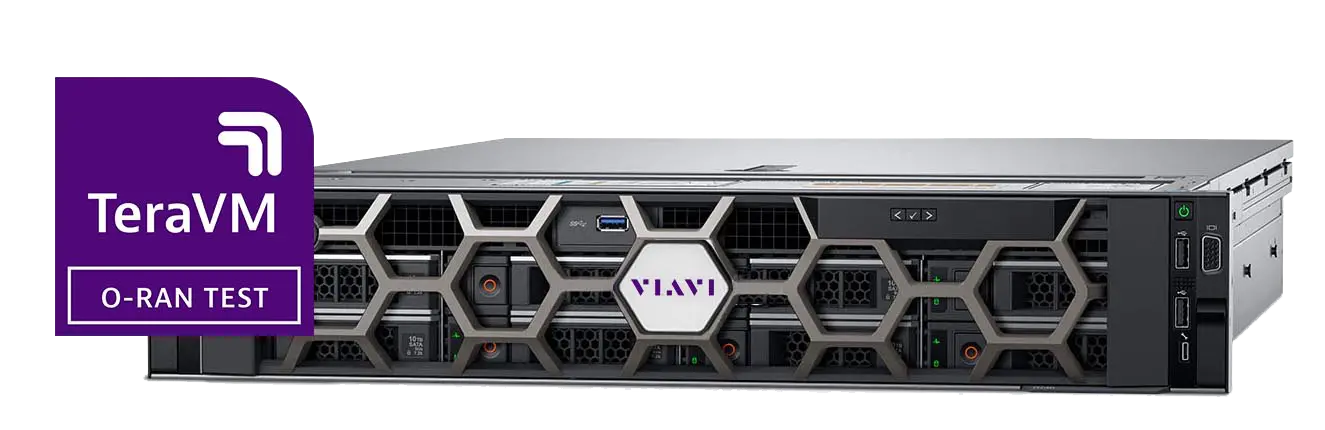
VIAVI TeraVM O-CU Tester with O-DU Simulator for O-RAN O-CU Wraparound Testing
Software-based O-CU subsystem tester that emulates O-DUs, UEs and core networks over F1, X2/Xn and S1/NG for O-RAN O-CU validation.
- Emulated DUs
- up to 64 DUs
- Connection attempts
- 40 million connection attempts per hour
- Traffic
- 50+ Gbps
Overview
The VIAVI TeraVM O-CU Tester with O-DU Simulator provides wraparound validation of the O-CU, the Open Central Unit of the disaggregated O-RAN gNB that is responsible for the RRC and PDCP layers. It is part of the TeraVM family, a fully virtualized set of test products that runs on x86 Commercial Off The Shelf (COTS) hardware or in the cloud, giving network equipment manufacturers and service providers a repeatable test environment that can be used without engineers entering the test lab.
The tester emulates many O-DUs and UEs to generate 5G control plane and/or user plane traffic towards the O-CU under test. Over the F1 interface it emulates network-topology and slice-aware UE sessions and O-DUs with stateful 3GPP and O-RAN compliant F1-C and F1-U procedures. Over X2 (NSA EN-DC) and Xn (SA) it emulates eNBs and gNBs, and over S1 (NSA EN-DC) and NG (SA) it emulates an EN-DC capable EPC or a 5G SBA core. Application traffic flows can be run over the established 4G PDN sessions and 5G network slices and PDU sessions.
The test suite checks that the O-CU conforms to 3GPP standards and O-RAN C-plane and U-plane profiles, interoperates with other 5G and O-RAN network functions, and performs under full load with complex mobile traffic profiles. Emulating high data rates and large numbers of O-DUs matters because the O-CU is the first data aggregation point between the RAN and the core. Negative test cases are supported as standard.
Optional elements
Other parts of the test suite are available as options to cover more use cases: a 5G SA/NSA Core Emulator for setups without a real core network, an X2 CU Tester for 5G NSA tests and an Xn CU Tester for 5G SA tests. The tester works alongside the VIAVI TM500 and other TeraVM products. It supports CI/CD integration and open-source automation tools such as Jenkins.
Key Features
- O-CU wraparound test compliant with latest 3GPP and O-RAN standards
- Runs in lightweight VM on standard COTS x86 hardware
- CI/CD automation integration
- Functional testing
- Performance and capacity testing
- Supports open source automation tools such as Jenkins
- Optional Core Emulator and vRAN Emulator
- Stateful 3GPP and O-RAN compliant F1-C and F1-U session emulation
- X2 (NSA EN-DC) and Xn (SA) eNB/gNB emulation with X2-C/U and Xn-C/U procedures
- S1 (NSA EN-DC) and NG (SA) core emulation with S1-MME/S1-U and NG-C/U procedures
- Application traffic flow emulation over 4G PDN sessions and 5G network slices and PDU sessions
- Negative test cases supported as standard
- Simultaneously emulates a large number of DU nodes at the F1 interface to the CU
- Delivers real traffic from large populations of UEs
- Tests both 5G SA and NSA scenarios
- Supports X2-U data traffic for split bearer testing
- Single API for test case definition
- Deploy and configure in real time
- Deterministic, consistent test outcomes
- Frequent updates to recent 3GPP specifications
Specifications
| Emulated DUs | up to 64 DUs |
|---|---|
| Connection attempts | 40 million connection attempts per hour |
| Traffic | 50+ Gbps |
| Network functions | O-DU Emulator |
|---|---|
| Interfaces | F1, X2 |
| Emulated interfaces (web page) |
F1-C/F1-U, X2-C/U, Xn-C/U, S1-MME/S1-U, NG-C/U
Xn, S1 and NG emulation listed on the product page; datasheet lists F1 and X2 for the O-CU Test DU Sim, with core and Xn testers as optional elements
|
| X2 |
3GPP TS 36.423: E-UTRAN – X2 Application Protocol
Contact VIAVI for latest spec compliance
|
|---|---|
| F1 |
3GPP TS 38.473: NG-RAN F1 Application Protocol
Contact VIAVI for latest spec compliance
|
| X2 procedures | X2 EN-DC Setup Procedure; X2 EN-DC Configuration Update Procedure; X2 Reset; X2 EN-DC Partial Reset |
|---|---|
| Secondary node procedures | Secondary Node Addition (Option 3a, 3x); Secondary Node Release (Option 3a, 3x); Secondary Node Change (Option 3a, 3x) |
| Mobility and security | MeNB Change; MeNB to eNB Change; PCell Change; Security Key Change Procedure; Addition/Removal of SN terminated split bearer |
| F1 procedures | F1 Setup/Reset; gNB-DU Configuration Update; gNB-CU Configuration Update; gNB-DU Resource Coordination; gNB-DU Status Indication; UE Context Setup/Release/Modification CU initiated and DU initiated; UL/DL RRC msg transfer |
| Server platform |
POWEREDGE R740
Datasheet page 3 also describes the system as 1U server based
|
|---|---|
| Processor | Two Intel® Xeon® Scalable processors, 18 cores per processor |
| Memory | 192 GB ECC DDR per server |
| Power supply | Platinum; Hot plug power supplies with full redundancy |
| Form factor | Rack (2U) |
| Max depth | 752 mm |
| Power dissipation | 550W/ 700W/ 850W maximum for 0/ 1/ 2 Radio Cards |
Specifications are taken from the manufacturer's documentation. See the datasheet for complete and current values.
Applications
- O-CU functional validation
- O-CU load and capacity testing
- O-RAN interoperability testing
- 5G SA and NSA (EN-DC) test scenarios
- Split bearer testing
- Network equipment manufacturer R&D
- Service provider pre-deployment verification
- CI/CD regression testing
Documents & Resources
Related Products
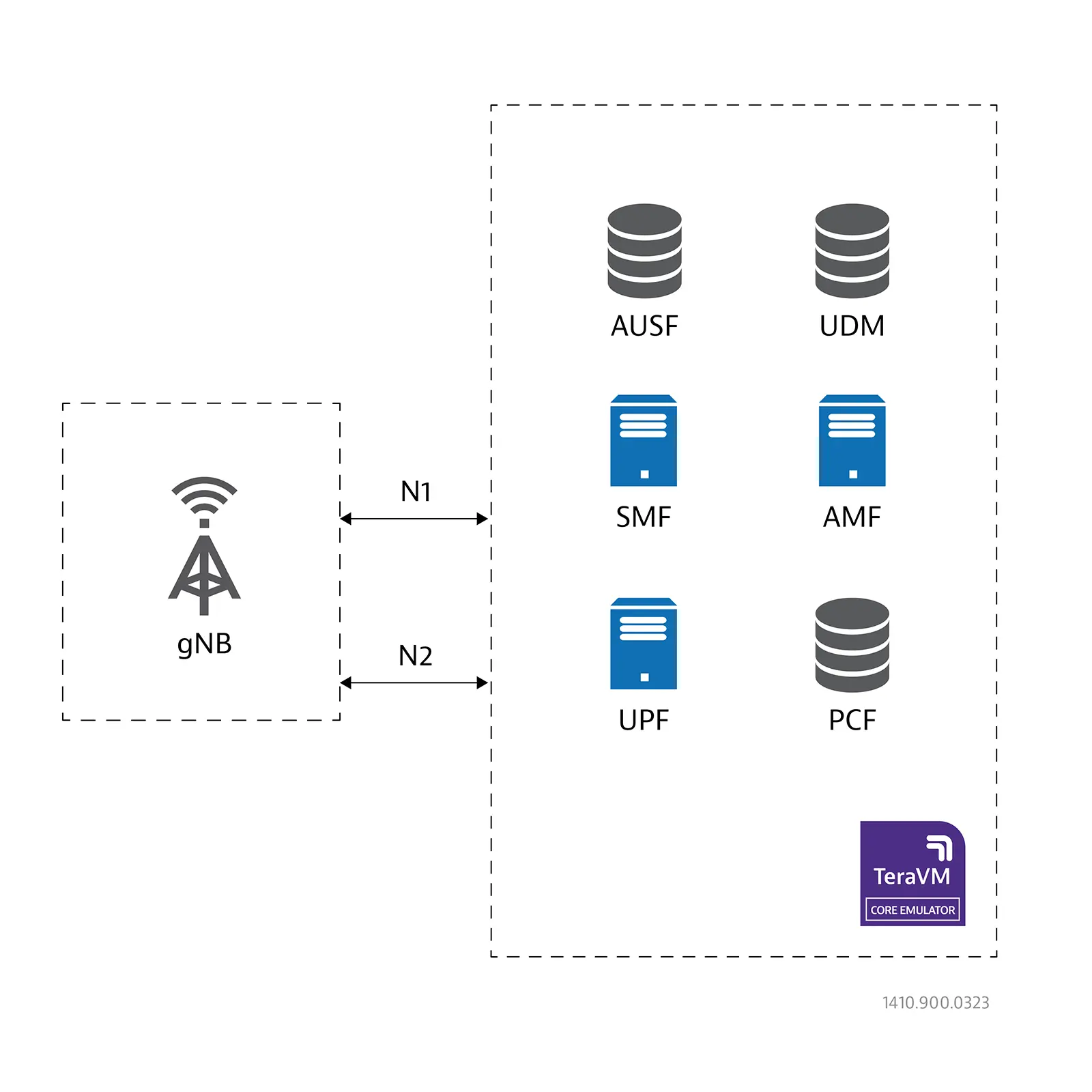
Virtualized 5G core network emulator that works with the TM500 test mobile for wrap-around testing of 5G gNBs in SA and NSA modes.
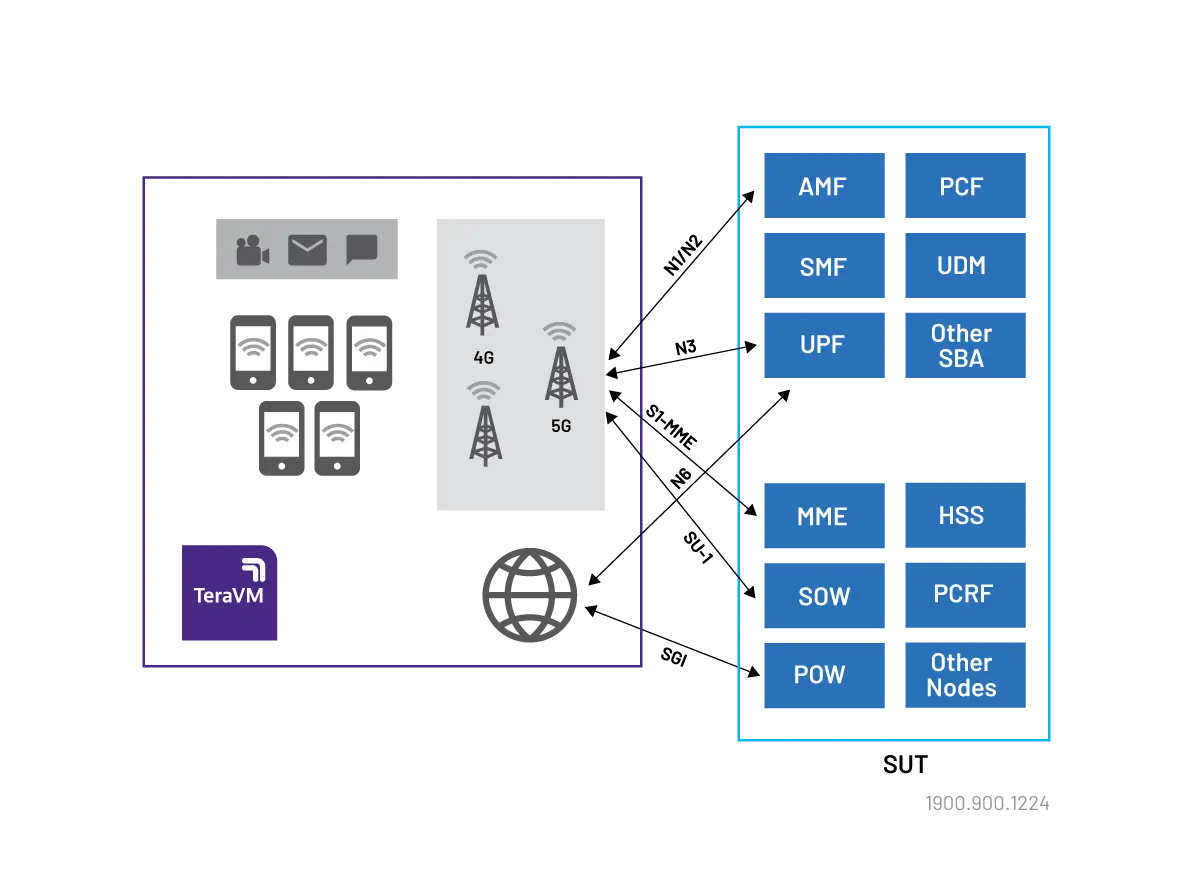
Virtualized test solution that emulates RAN, UEs and applications for full wraparound validation of 5G SA/NSA and 4G/3G/2G core networks.
Virtualized endpoint emulation platform for validating VPN, ZTNA, SASE, firewall and application security performance at scale.

Software-only TeraVM test solution providing an elastic test bed for repeatable validation of virtualized, NFV and cloud networks.