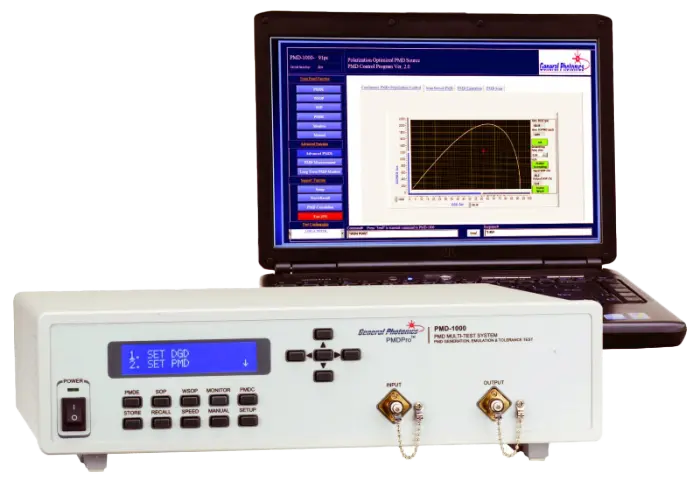
PMDPro PMD-1000 Polarization Mode Dispersion Emulator/Source
Digital PMD source that deterministically generates 1st order PMD up to 180 ps and 2nd order PMD up to 8100 ps2.
- Operating wavelength range
- C band or L band
- Insertion loss
- 5.0 dB
- Insertion loss
- 5.5 dB
- Input power range
- -10 to 10 dBm
Overview
The PMD-1000 (PMDPro) is a digital polarization mode dispersion (PMD) source that deterministically generates 1st order PMD up to 180 ps and 2nd order PMD (SOPMD) up to 8100 ps2. It uses birefringent crystals and ternary magneto-optic rotators to generate PMD, with a PMD switching time as short as one millisecond.
A quasi-continuous operation mode allows independent generation of first order and wavelength-independent second order PMD for uniform coverage of the PMD space. In addition to static combinations of DGD and SOPMD, the instrument can perform grid and continuous-trace PMD scans as well as statistical PMD emulation.
Polarization control and monitoring
The PMD-1000 contains a polarization controller and two polarimeters located before and after the PMD generating element, monitoring the state of polarization (SOP) and degree of polarization (DOP). The polarization controller can scramble the input polarization to average out its effect on the PMD generator.
For single-polarization signals, the controller and polarimeters allow the instrument to automatically adjust the input polarization to obtain the worst-case PMD effect at any PMD setting, or to maximize output DOP for optical PMD compensation. The instrument can also perform deterministic polarization control functions, including trace generation and polarization stabilization at any SOP.
Key Features
- Generates 1st and 2nd order PMD
- 1st and 2nd order PMD emulation
- Rapid PMD switching (1 ms)
- Automatic polarization alignment
- Polarization scrambling
- PMD compensation
- PMD statistical emulation
- Grid and continuous-trace PMD scans
- Built-in polarization controller and two polarimeters
Specifications
| Operating wavelength range |
C band or L band
Standard option: C band
|
|---|---|
|
Insertion loss
90 ps version
|
5.0 dB |
|
Insertion loss
180 ps version
|
5.5 dB |
| Input power range | -10 to 10 dBm |
| Return loss | 50 dB |
|
PDL
90 ps version
|
0.45 dB
typical
|
|
PDL
180 ps version
|
0.5 dB
typical
|
| Optical power handling | 300 mW min. |
|
1st order PMD range
90 ps version
|
0 to 91 ps |
|---|---|
|
1st order PMD range
180 ps version
|
0.36 to 182.4 ps |
|
1st order PMD resolution (discrete mode)
90 ps version
|
0.357 ps |
|
1st order PMD resolution (discrete mode)
180 ps version
|
0.714 ps |
|
1st order PMD resolution (quasi-continuous mode)
90 ps version
|
0.1 ps |
|
1st order PMD resolution (quasi-continuous mode)
180 ps version
|
0.2 ps |
|
2nd order PMD range
90 ps version
|
2000 ps2 |
|
2nd order PMD range
180 ps version
|
8100 ps2 |
| PMD variation time | 1 ms min. |
| SOP alignment accuracy |
±2°
At 23 ± 5°C
|
|---|---|
| DOP accuracy |
±2%
At 23 ± 5°C
|
| Communications interfaces | USB, RS-232, Ethernet, and GPIB |
|---|---|
| Front panel display | 2 x 20 character LCD |
| Connector type |
FC/PC, FC/APC, SC/PC, or SC/APC
Ordering option
|
| Operating temperature | 10 to 50 °C |
|---|---|
| Storage temperature | -20 to 60 °C |
| Power supply | 100–240 VAC, 50–60 Hz |
| Dimensions | 2U, 3/4 of 19" rack width; 14" (L) x 14" (W) x 3.5" (H) |
Specifications are taken from the manufacturer's documentation. See the datasheet for complete and current values.
Applications
- System PMD tolerance testing
- Tracking speed testing
- PMD compensator evaluation
- System PMD emulation
- Optimizing PMD values for PMD compensation
- PMD measurement instrument calibration
- Polarization performance testing of coherent receivers
Options & Accessories
| Option | Description |
|---|---|
| 90 | DGD range 90 ps |
| 18 | DGD range 180 ps |
| C | C band wavelength — Standard option |
| L | L band wavelength |
Documents & Resources
Related Products
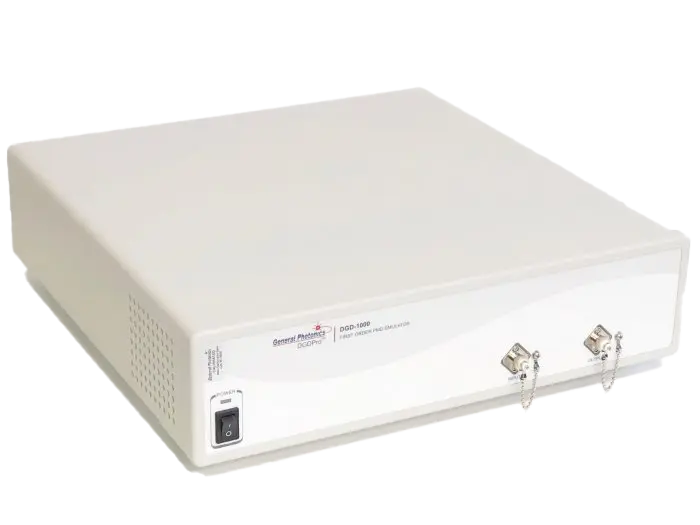
First order PMD source that generates precise differential group delay (DGD) of up to 400 ps with no second order PMD.
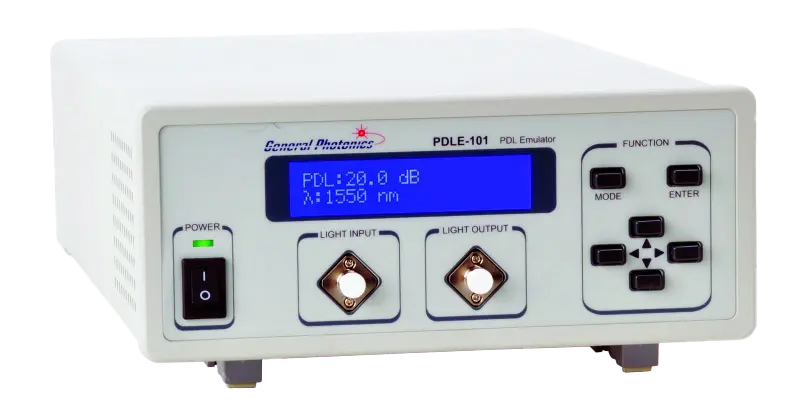
PDL source/emulator that generates polarization dependent loss values up to 20 dB with 0.1 dB resolution for PDL tolerance testing.
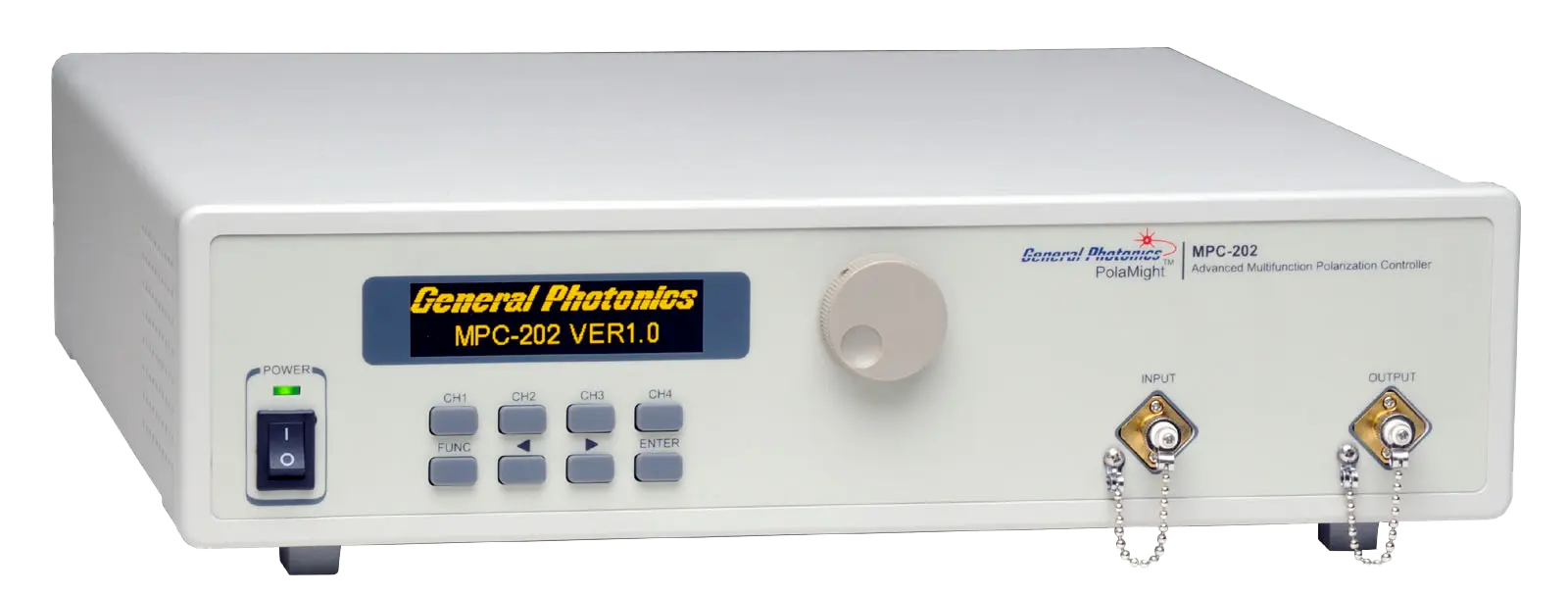
Multifunction polarization controller with high-speed Tornado scrambling and square-wave SOP transitions for coherent receiver stress testing.