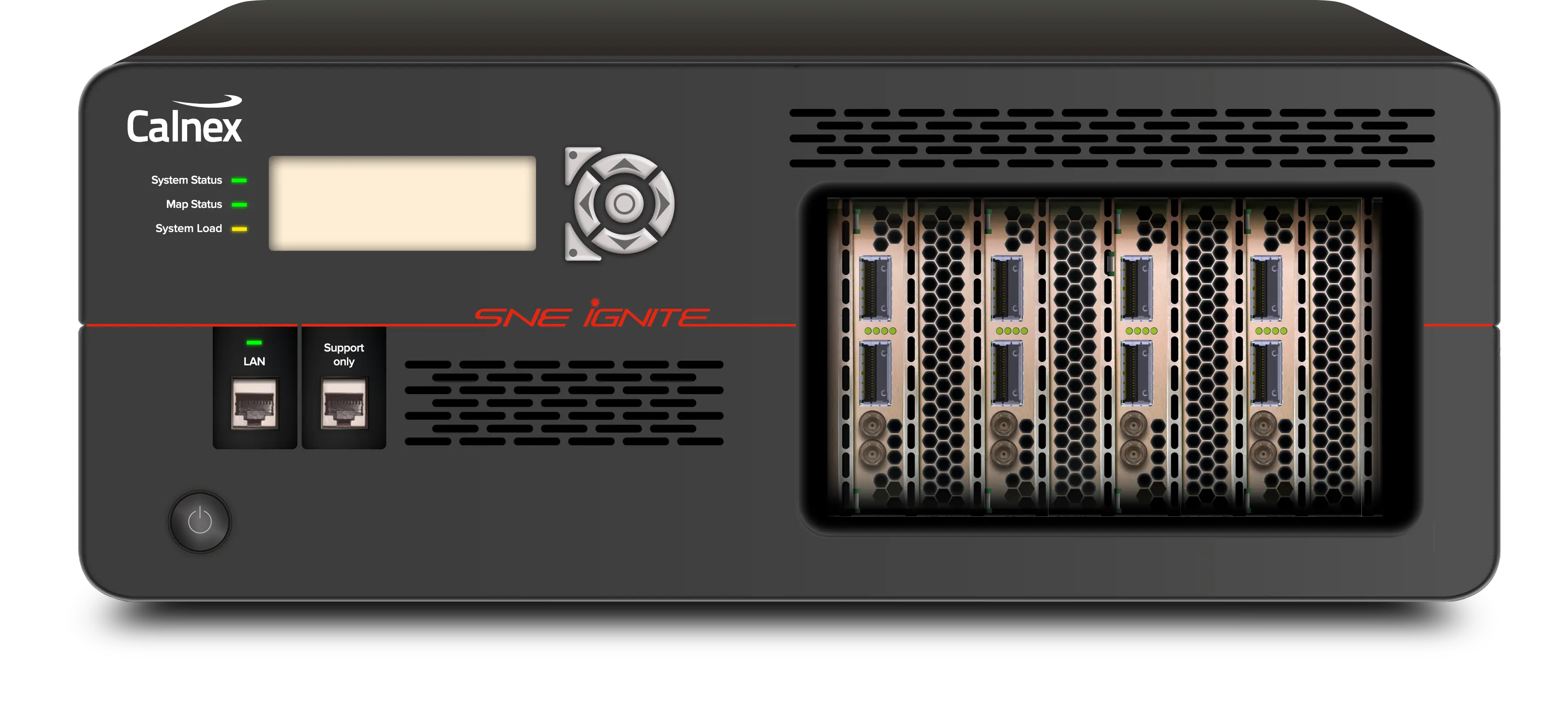
Calnex SNE Ignite 400G Network Emulator for AI Infrastructure Validation
400GbE network emulator that applies controlled impairments to AI and RDMA traffic at full line rate with transparent PFC pass-through.
- Ports
- 8 x 100GbE, 2 x 400GbE
- Network Interfaces
- 100GbE – QSFP28, 400GbE – QSFP-DD
- Dimensions
- 3.7U
- Passthrough PFC Frames Transparently
- Yes
Overview
The Calnex SNE Ignite 400G is a network emulator designed for AI backend and data center interconnect (DCI) environments. It is used to validate RoCE transport, congestion control, PFC tuning and workload resilience across scale-out clusters and long-distance scale-across architectures by applying precise, repeatable impairments to live AI traffic paths in the lab.
AI fabrics behave differently from traditional enterprise or telecom networks. GPU and xPU workloads can create intense, synchronized bursts, while RDMA transport places strict requirements on latency, ordering, congestion response and packet delivery. Small amounts of packet loss, delay variation or poor congestion control can affect job completion time, fabric utilization and overall workload efficiency.
PFC and congestion control
DCQCN on the endpoints, together with PFC and ECN on the switches, maintains utilization and predictable behavior in Ethernet fabrics. The SNE Ignite 400G does not terminate PFC frames; it can intercept and delay or otherwise impair them, so engineers can validate XON/XOFF thresholds, pause duration and buffer management behavior across emulated network distances.
RDMA, RoCE and Ultra Ethernet
The instrument allows RDMA traffic to be tested at 400GbE with 100% throughput and zero loss. Because it understands RDMA semantics and RoCE headers, RoCEv2 congestion control, timeout behavior, retransmission handling and recovery can be evaluated end to end. Repeatable delay, loss, corruption, reordering and asymmetry can also be applied to validate Ultra Ethernet mechanisms and interoperability.
Scale-across and DCI
Long-distance link conditions can be recreated in the lab without physical fiber spools, making it easier to isolate transport behavior, tune PFC parameters and validate DCI scenarios under controlled conditions.
Architecture and control
The SNE Ignite 400G runs on a purpose-built FPGA architecture that maintains full line-rate operation during impairment. It is operated through a graphical map-based web user interface and a RESTful API for test automation.
Key Features
- Bi-directional 400G IP stream at full line rate
- Designed for RoCEv2 and RDMA environments
- PFC frames pass through transparently to preserve RoCEv2 congestion control
- PFC tuning for DCI and scale-across AI clusters by reproducing distance-induced delay
- Controlled impairments: delay, jitter, drop, corruption, duplication, reordering and modification
- L2/L3/L4 checksum regeneration
- 100% throughput of any traffic, including RDMA, PFC and DCQCN/CNP
- Live real-time modification of any impairment setting
- Timeline scheduling of emulation settings with optional loop playback
- Purpose-built FPGA architecture for high-precision impairment
- Graphical map-based web user interface
- RESTful API for test automation
- Port and impairment node level packet statistics with .CSV and .JSON export
Specifications
| Ports | 8 x 100GbE, 2 x 400GbE |
|---|---|
| Network Interfaces | 100GbE – QSFP28, 400GbE – QSFP-DD |
| Dimensions | 3.7U |
| Passthrough PFC Frames Transparently | Yes |
| SyncE Passthrough | Clock can be recovered on one port and passed transparently to another. |
| Clock Reference | Internal or External (10 MHz) |
| Live Changes |
Yes
Real-time modification of any impairment setting
|
|---|---|
| Bi-directional 400G IP Stream at Full Line Rate | Yes |
| 100% Throughput of any traffic, including RDMA, PFC, DCQCN/CNP | Yes |
| Timeline |
Yes
Schedule changes to emulation settings with no manual intervention required. Option: loop timeline for continuous playback
|
| Impairment profiles | 8 |
|---|---|
| Delay | up to 320ms |
| Jitter | Yes |
| Corruption | Yes |
| Duplication | Yes |
| Drop | Yes |
| Modify | Invert, Static, Increment, Decrement and Fuzz |
| Regenerate L2, L3, L4 Checksums | Yes |
| PFC Frames | Yes |
|---|---|
| MAC Address | Yes |
| IPv4 / IPv6 | Yes |
| UDP | Yes |
| VLAN | Yes |
| TCP | Yes |
| MPLS | Yes |
| DiffServ / DSCP | Yes |
| Intuitive Web UI | Yes |
|---|---|
| RESTful API for Test Automation | Yes |
| Smart-Start Up |
Yes
Automatically launch previous map on boot
|
| Map Statistics |
Yes
Port and impairment node level packet statistics UI, .CSV and .JSON
|
Specifications are taken from the manufacturer's documentation. See the datasheet for complete and current values.
Applications
- AI backend network validation
- Data center interconnect (DCI) testing
- Scale-out and scale-across AI cluster testing
- RoCEv2 and RDMA protocol validation
- PFC, ECN and DCQCN tuning
- Ultra Ethernet mechanism validation
- Accelerator, NIC and switch silicon verification
- SmartNIC and HW offload testing
- Switch buffer, hashing and forwarding validation
- SONiC testing
- AI inference network testing
Documents & Resources
Related Products
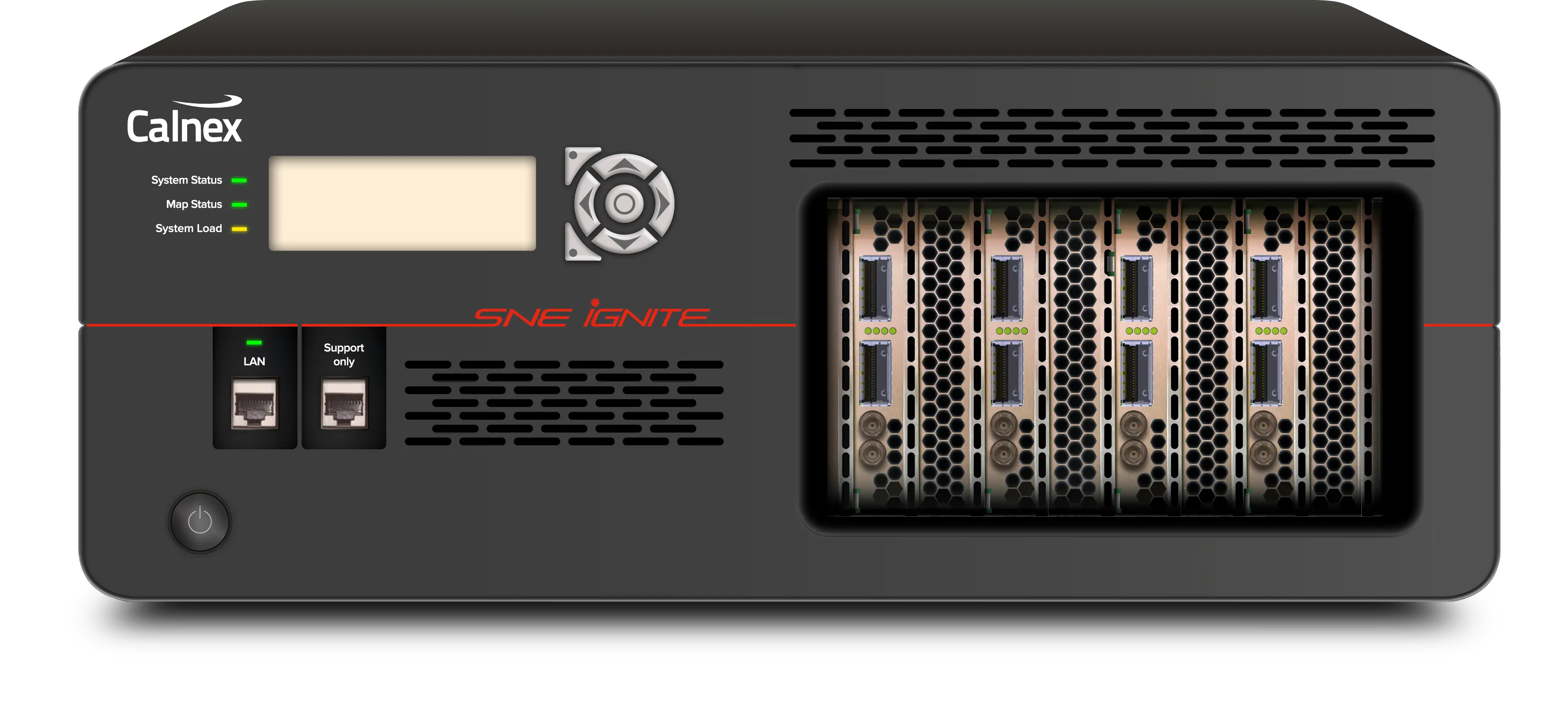
FPGA-based multi-port network emulator with 6.8 µs intrinsic latency and line-rate impairments from 10GbE to 400GbE.
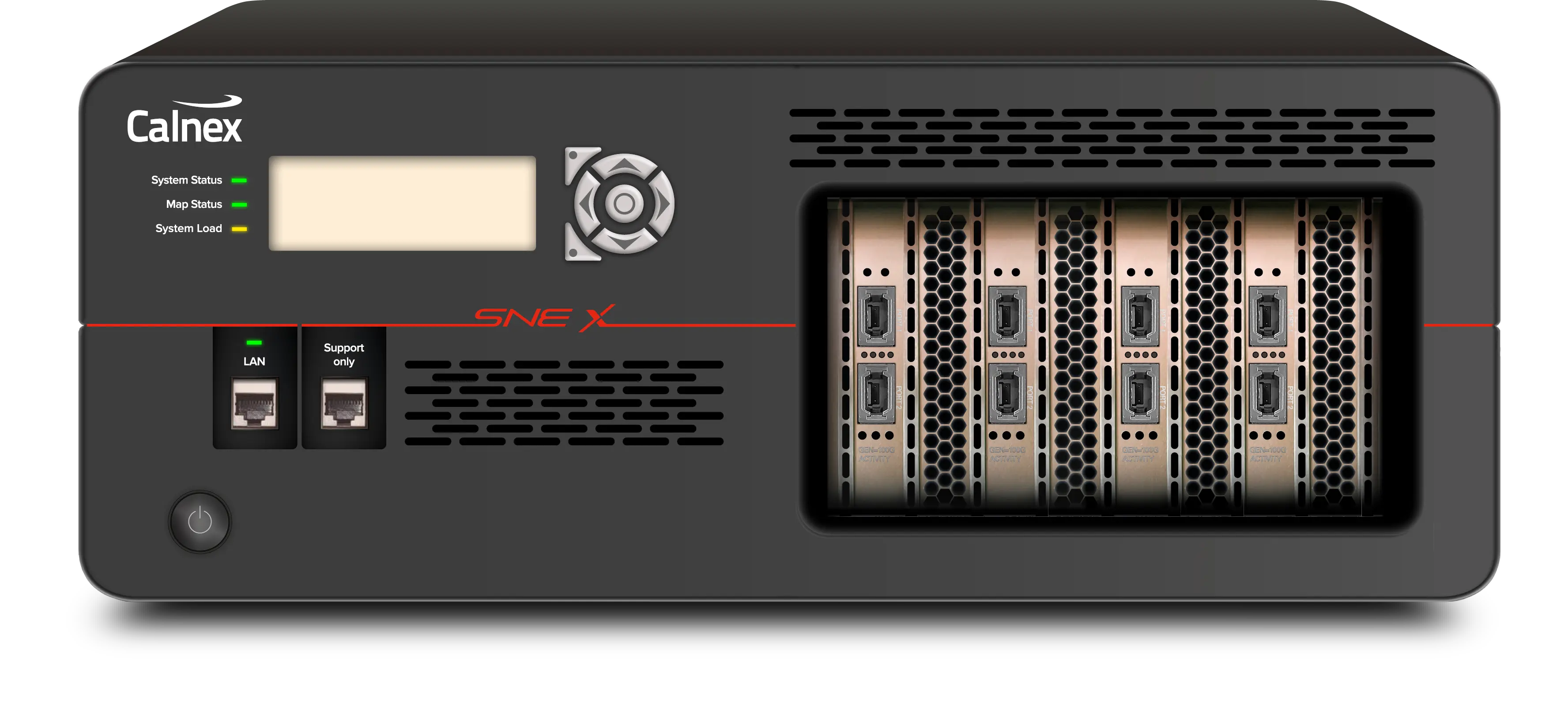
Multi-port network emulator with up to 28 ports and 1GbE to 400GbE wire-rate impairment of hundreds of packet streams.