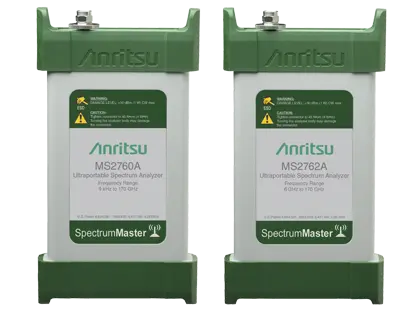
Spectrum Master MS2760A-0170 Ultraportable Spectrum Analyzer, 9 kHz to 170 GHz
USB-powered ultraportable spectrum analyzer covering 9 kHz to 170 GHz continuously, controlled from a Windows PC, laptop or tablet.
- Frequency Range
- 9 kHz to 170 GHz
- Tuning Resolution
- 1 Hz
- Internal 10 MHz Frequency Reference, Aging
- ±1.0 ppm/year
- Internal 10 MHz Frequency Reference, Accuracy
- ±0.2 ppm (25 °C ± 25 °C) + aging
Overview
The Spectrum Master MS2760A-0170 is the 170 GHz frequency option of the Anritsu MS2760A ultraportable spectrum analyzer family. It provides broadband, continuous coverage from 9 kHz to 170 GHz in a pocket-sized instrument. It is one of the two MS2760A models (with the MS2760A-0145) that extend above the 110 GHz barrier and cover the entire D band.
The analyzer uses Anritsu's patented nonlinear transmission line (NLTL) technology, the same technology used in Anritsu vector network analyzers. Its small size allows it to connect directly to the device under test through its 0.8 mm test port. This avoids long test port cables, whose loss becomes significant at millimeter-wave frequencies.
The instrument is USB-powered and controlled from a Windows-based PC, laptop or tablet, so it can be used in the lab, on a production line or in the field. Measurements include channel power, adjacent channel power and occupied bandwidth, with spectrum and spectrogram displays. The analyzer also accepts an external 10 MHz frequency reference and an external TTL trigger input.
Typical applications include radio astronomy, automotive radar, antenna beam pattern testing, wireless backhaul, satellite communications and 802.11ad/WiGig spectral mask testing. For over-the-air measurements, a waveguide horn antenna can be attached directly to the test port.
Key Features
- Continuous frequency coverage from 9 kHz to 170 GHz
- Patented nonlinear transmission line (NLTL) technology
- Ultraportable form factor enables measurements right at the device under test
- USB-powered and controlled from a Windows-based PC, laptop, or tablet
- Measure: channel power, adjacent channel power, occupied bandwidth
- Spectrum and spectrogram displays
- Up to 6 traces, 3 trace detectors, and 12 markers
- Resolution bandwidth (RBW) from 1 Hz to 3 MHz
- External 10 MHz frequency reference input
- External TTL trigger input
- 0.8 mm (m) test port connector
Specifications
| Frequency Range |
9 kHz to 170 GHz
Usable to 0 Hz; 160 GHz to 170 GHz is typical
|
|---|---|
| Tuning Resolution | 1 Hz |
| Internal 10 MHz Frequency Reference, Aging | ±1.0 ppm/year |
| Internal 10 MHz Frequency Reference, Accuracy | ±0.2 ppm (25 °C ± 25 °C) + aging |
| Frequency Span | 10 Hz to maximum frequency range of instrument |
| Resolution Bandwidth (RBW) |
1 Hz to 3 MHz
Span ≥10 Hz; Zero Span 5 kHz to 20 MHz
|
|---|---|
| Video Bandwidth (VBW) |
1 Hz to 3 MHz
Span ≥10 Hz; Zero Span 5 kHz to 20 MHz
|
| VBW/Average Type | Linear / Log |
| RBW Filters | Flat Top, Nuttall |
| Shape Factor |
<5:1
typical
|
| Dynamic Range |
> 103 dB typical at 70 GHz
2/3 (TOI – DANL) in 1 Hz RBW
|
|---|---|
| Display Range | 1 dB to 15 dB/div in 1 dB steps, ten divisions displayed |
| Measurement Range | DANL to +10 dBm |
| Reference Level Range | –120 dBm to +30 dBm |
| Amplitude Units | dBm |
| Maximum Safe Level Input | +30 dBm CW, ±10 VDC |
| 9 kHz to 644 MHz |
±1.3 dB maximum, ±0.5 dB typical
-10 dBm CW signal, 20 °C to 30 °C (after 30 minute warm-up); 0 °C to 50 °C: ±2.0 dB maximum, ±0.5 dB typical
|
|---|---|
| > 644 MHz to 40 GHz |
±1.8 dB maximum, ±0.5 dB typical
20 °C to 30 °C; 0 °C to 50 °C: ±3.0 dB maximum, ±1.0 dB typical
|
| > 40 GHz to 70 GHz |
±2.0 dB maximum, ±0.5 dB typical
20 °C to 30 °C; 0 °C to 50 °C: ±3.0 dB maximum, ±1.0 dB typical
|
| > 70 GHz to 90 GHz |
±2.2 dB maximum, ±0.5 dB typical
20 °C to 30 °C; 0 °C to 50 °C: ±3.0 dB maximum, ±1.0 dB typical
|
| > 90 GHz to 110 GHz |
±2.5 dB maximum, ±0.5 dB typical
20 °C to 30 °C; 0 °C to 50 °C: ±3.0 dB maximum, ±1.0 dB typical
|
| > 110 GHz to 145 GHz |
±3.5 dB maximum, ±0.5 dB typical
20 °C to 30 °C; 0 °C to 50 °C: ±4.0 dB maximum, ±1.5 dB typical
|
| > 145 GHz to 170 GHz |
±3.5 dB maximum, ±0.5 dB typical
20 °C to 30 °C; 0 °C to 50 °C: ±4.0 dB maximum, ±1.5 dB typical; amplitude accuracy > 160 GHz typical
|
| 10 MHz to 670 MHz |
–131 dBm maximum, –134 dBm typical
RMS detection, VBW/Avg type = Log, IF Gain On, 1 Hz RBW
|
|---|---|
| > 670 MHz to 4 GHz |
–136 dBm maximum, –140 dBm typical
RMS detection, IF Gain On, 1 Hz RBW
|
| > 4 GHz to 40 GHz |
–131 dBm maximum, –134 dBm typical
RMS detection, IF Gain On, 1 Hz RBW
|
| > 40 GHz to 70 GHz |
–128 dBm maximum, –132 dBm typical
RMS detection, IF Gain On, 1 Hz RBW
|
| > 70 GHz to 90 GHz |
–127 dBm maximum, –130 dBm typical
RMS detection, IF Gain On, 1 Hz RBW
|
| > 90 GHz to 110 GHz |
–123 dBm maximum, –127 dBm typical
RMS detection, IF Gain On, 1 Hz RBW
|
| > 110 GHz to 145 GHz |
–112 dBm maximum, –120 dBm typical
RMS detection, IF Gain On, 1 Hz RBW
|
| > 145 GHz to 170 GHz |
–107 dBm maximum, –114 dBm typical
RMS detection, IF Gain On, 1 Hz RBW
|
| SSB Phase Noise, 1 kHz offset |
–100 dBc/Hz
1 GHz, typical, 20 °C to 30 °C
|
|---|---|
| SSB Phase Noise, 10 kHz offset |
–110 dBc/Hz
1 GHz, typical, 20 °C to 30 °C
|
| SSB Phase Noise, 100 kHz offset |
–116 dBc/Hz
1 GHz, typical, 20 °C to 30 °C; the Quick Fact Sheet states –110 dBc/Hz @ 1 GHz, typical
|
| SSB Phase Noise, 100 kHz offset at 60 GHz |
–75 dBc/Hz maximum, –84 dBc/Hz typical
20 °C to 30 °C
|
| Third-Order Intercept (TOI), 2 GHz |
+35 dBm
IF Gain Off, typical, 0 dBm tones 1 MHz apart, 0 dBm reference level
|
| Third-Order Intercept (TOI), 18 GHz |
+35 dBm
IF Gain Off, typical
|
| Third-Order Intercept (TOI), 62 GHz |
+25 dBm
IF Gain Off, typical
|
| Second Harmonic Distortion, 0 dBm input |
–50 dBc maximum
at 1 GHz input
|
| Second Harmonic Distortion, –20 dBm input |
–60 dBc maximum
at 1 GHz input
|
| Residual Spurs, 10 MHz to 70 GHz | –85 dBm maximum, –95 dBm typical |
|---|---|
| Residual Spurs, > 70 GHz to 90 GHz | –84 dBm maximum, –95 dBm typical |
| Residual Spurs, > 90 GHz to 110 GHz | –81 dBm maximum, –95 dBm typical |
| Residual Spurs, > 110 GHz to 145 GHz | –68 dBm maximum, –85 dBm typical |
| Residual Spurs, > 145 GHz to 170 GHz | –64 dBm maximum, –72 dBm typical |
| Input-related Spurious, all other input frequencies |
<–60 dBc
–10 dBm CW input; exceptions at 28 MHz, 35 MHz, 770 MHz and 910 MHz listed in datasheet
|
| 9 kHz to 12.4 GHz | 1.29:1 VSWR, 18 dB return loss |
|---|---|
| > 12.4 GHz to 26.5 GHz | 1.67:1 VSWR, 12 dB return loss |
| > 26.5 GHz to 40 GHz | 1.67:1 VSWR, 12 dB return loss |
| > 40 GHz to 50 GHz | 1.67:1 VSWR, 12 dB return loss |
| > 50 GHz to 70 GHz | 2.10:1 VSWR, 9 dB return loss |
| > 70 GHz to 110 GHz | 2.32:1 VSWR, 8 dB return loss |
| > 110 GHz to 145 GHz | 3.56:1 VSWR, 5 dB return loss |
| > 145 GHz to 170 GHz | 4.42:1 VSWR, 4 dB return loss |
| Source | External, Free Run, Video, Periodic (0 s to 5 s) |
|---|---|
| Delay | 0 ms to 1670 ms; –60 s (up to sweep time) in zero span and video or external trigger |
| Holdoff | 0 ms to 5000 ms |
| Slope | Rising, Falling, Both |
| Hysteresis | 0 dB to 200 dB |
| Smart Measurements | Channel Power, Occupied Bandwidth, Adjacent Channel Power |
|---|---|
| Zero Span Sweep Time | 0.02 ms to 60 s |
| Sweep (Trace) Points | Settable range from 10 to 10,001 points; the default is 501 points |
| Sweep Time Accuracy | ± 2% in Zero Span |
| Traces | Up to six traces |
| Detector Type per Trace | Peak, RMS / Avg, Negative |
| Markers | Up to 12 Markers |
| Spectrogram Trace Time Cursor | Up to six Time Cursors to recall historical trace data by trace number or time |
| RF In |
0.8 mm Connector, male 50Ω
145 GHz and 170 GHz instruments
|
|---|---|
| USB Interface | USB 3.0, Type C Connector |
| External Reference In | MCX(f), 50Ω, 10 MHz |
| External Trigger In | MCX(f), 50Ω, TTL Levels |
| Display Resolution | 16:9 / 16:10 Aspect Ratio (>1280 x 720 / 1280 x 800) |
|---|---|
| Operating System | Windows® 7, 8.1, 10; 64-bit |
| Recommended Minimum Configuration | Quad Core i7 fourth generation or higher CPU, 16 GB RAM, 128 GB Data Storage, USB 3.0 |
| Environmental Standard |
MIL-PRF-28800F Class 3
not including Windows Tablet/Laptop/PC
|
|---|---|
| Operating Temperature Range | 0 ºC to 50 ºC |
| Storage Temperature Range | –40 ºC to 71 ºC |
| Maximum Relative Humidity | 95 % RH at 30 ºC, non-condensing |
| Vibration, Sinusoidal | 5 Hz to 55 Hz |
| Vibration, Random | 10 Hz to 500 Hz |
| Half Sine Shock | 30 g |
| Altitude | 4600 meters, operating and non-operating |
| Size |
155 mm x 84 mm x 27 mm (6.1 in x 3.3 in x 1.1 in)
not including Windows Tablet/Laptop/PC
|
|---|---|
| Weight | 255 g (9.0 oz) |
| Warranty |
Standard one-year warranty
Product page and Quick Fact Sheet state a standard three-year warranty
|
| Calibration Cycle | Recommended calibration cycle is 12 months |
| Safety | EN 61010-1:2010 |
Specifications are taken from the manufacturer's documentation. See the datasheet for complete and current values.
Applications
- Radio astronomy
- Automotive radar testing
- Antenna beam pattern testing
- Wireless backhaul
- Satellite communications
- 802.11ad/WiGig spectral mask testing
- 5G and mmWave device development
- On-wafer spectrum measurements
- D band research and development
- RF component and device characterization on the production line
- Electronic warfare and radar
Included
- USB 3.0 Type C to Type A Cable, 1 m (2000-1859-R)
- BNC(m) to MCX(m) Cable, qty 2 (2000-1605-R)
- Certificate of Calibration and Conformance
Options & Accessories
| Option | Description |
|---|---|
| MS2760A-0170-0097 | Accredited Calibration to ISO17025 and ANSI/NCSL Z540-1 — Includes calibration certificate, test report, and uncertainty data |
| MS2760A-0170-0098 | Standard Calibration to ISO17025 and ANSI/NCSL Z540-1 — Includes calibration certificate |
| MS2760A-0170-0099 | Premium Calibration to ISO17025 and ANSI/NCSL Z540-1 — Includes calibration certificate, test report, and uncertainty data |
| 33.8.850 | Calibration Grade Adapter, 0.8 mm (m) to 0.8 mm (m), DC to 145 GHz, 50Ω |
| 33.8.8F50 | Calibration Grade Adapter, 0.8 mm (m) to 0.8 mm (f), DC to 145 GHz, 50Ω |
| 33.8F.8F50 | Calibration Grade Adapter, 0.8 mm (f) to 0.8 mm (f), DC to 145 GHz, 50Ω |
| 33W.850 | Calibration Grade Adapter, W1(m) to 0.8 mm (m), DC to 110 GHz, 50Ω |
| 33W.8F50 | Calibration Grade Adapter, W1(m) to 0.8 mm (f), DC to 110 GHz, 50Ω |
| 33WF.850 | Calibration Grade Adapter, W1(f) to 0.8 mm (m), DC to 110 GHz, 50Ω |
| 33WF.8F50 | Calibration Grade Adapter, W1(f) to 0.8 mm (f), DC to 110 GHz, 50Ω |
| SM7060 | Waveguide to Coaxial End Launch Adapter, 110 GHz to 145 GHz, WR6 to 0.8 mm(f) |
| 3670.850-1 | Test Port Cable, Armored, Semi-rigid, 0.8 mm(m) to 0.8 mm(f) 10 cm |
| 3670.850-2 | Test Port Cable, Armored, Semi-rigid, 0.8 mm(m) to 0.8 mm(f) 16 cm |
| 01-524 | Torque Wrench, 0.45 N·m (4 lbf·in) for 0.8 mm connectors |
| 2000-1888-R | USB 3.0 Powered Extension Cable, 10 m (32 ft) — Up to two can be used in series for a total length of 20 m |
| 2000-1918-R | 4-port 200 m USB Multimode Fiber Extender System |
| 760-291-R | Transit Case |