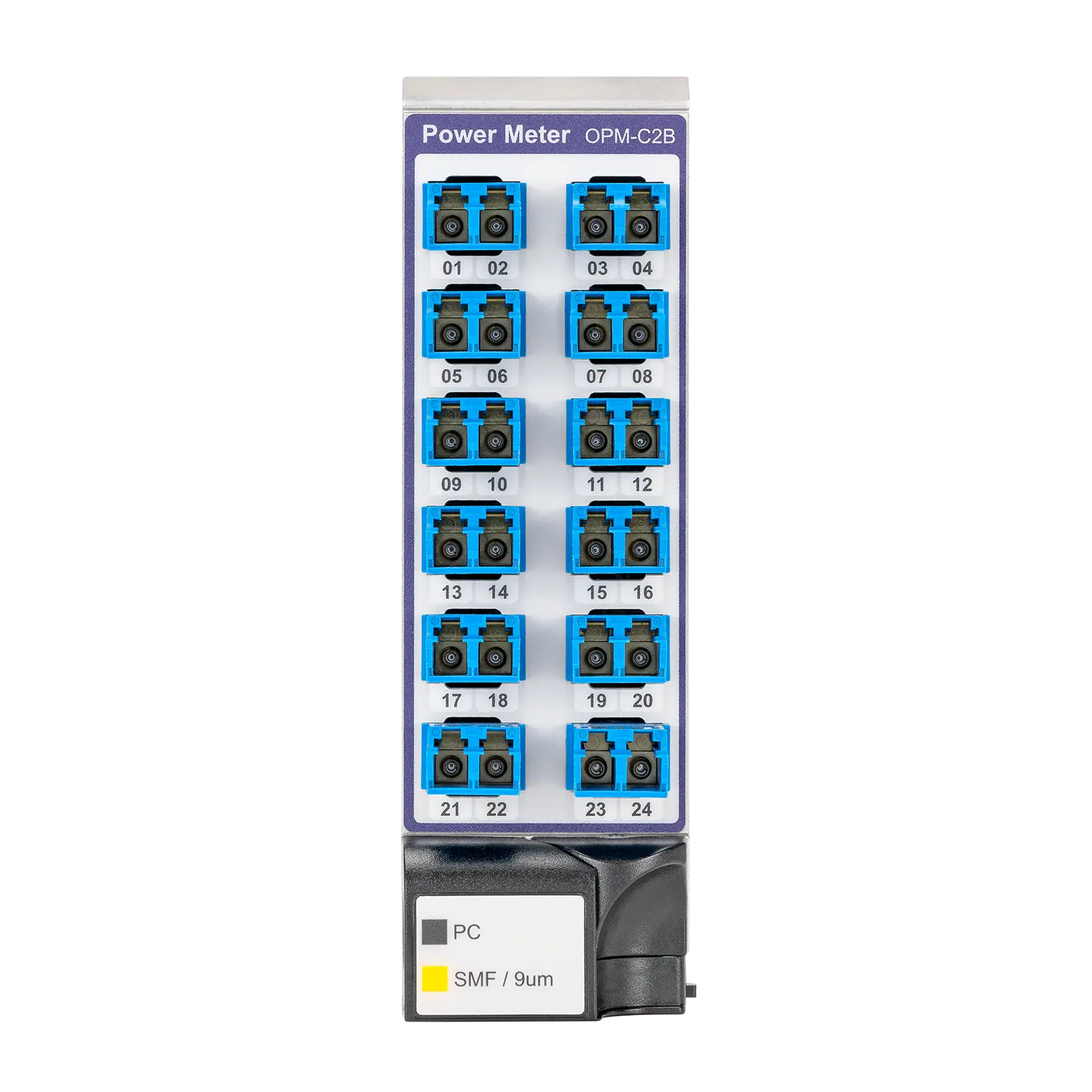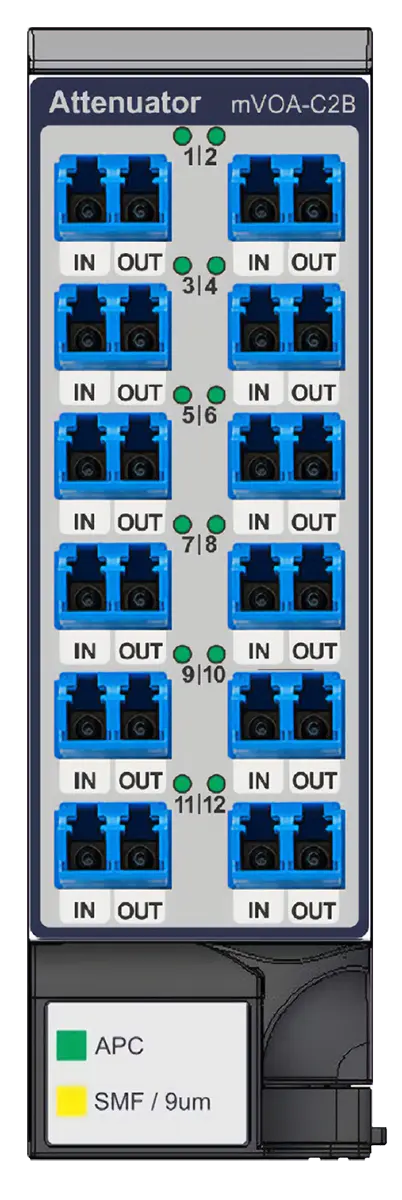
MAP Series mVOA-C2B MVOA-C2B08-SB1-M100-MLC 8-Device Variable Optical Attenuator with In/Out Monitors, LC/PC
MEMS-based MAP Series attenuator module with 8 attenuators, input/output power monitors and singlemode LC/PC connectors.
- Configuration
- Input and Output Monitor
- Number of Channels
- 8
- Connector
- LC/PC
Overview
The MVOA-C2B08-SB1-M100-MLC is a configuration of the VIAVI mVOA-C2B high-density variable optical attenuator module for the MAP-300 platform. It contains eight attenuator devices, each with input and output power monitors, and uses singlemode fiber with LC/PC connectors.
The mVOA-C2B is a precision MEMS mirror-based attenuator that succeeds the mVOA-C1. It is a single-slot, hot-pluggable cassette designed for all MAP-300 generation mainframes; up to eight modules fit in one 3U MAP-300 mainframe, supporting up to 96 independently controlled attenuators. Typical uses include client optic testing, next-generation coherent interfaces, long-haul network stress testing, network emulation and silicon photonics development.
Operating modes
In Attenuator Mode, the user enters the desired attenuation through the user interface or a remote SCPI command and the module sets it directly. Because this variant has in/out monitors, it also supports Constant Power Mode, in which the monitors actively control the attenuator to hold a target output power as the input power changes, and IL Mode, in which VIAVI calibration lets the user set the insertion loss across the input and output ports.
Key Features
- Eight independently controlled attenuators in a single-slot MAP module
- Input and output tap-coupled power monitors on each device
- MEMS mirror-based attenuation
- Attenuator, Constant Power and IL operating modes
- Control via user interface or remote SCPI commands
- Singlemode fiber with LC/PC connectors
- Hot-pluggable cassette for all MAP-300 generation mainframes
- Up to 96 attenuators in a single 3U MAP-300 mainframe
- Low insertion loss, return loss and PDL
- Fast transition speed and settling time
- Flat spectral response for CWDM and DWDM applications
- High input power capability for EDFA testing and multi-wavelength applications
Specifications
| Configuration | Input and Output Monitor |
|---|---|
| Number of Channels |
8
Series available with 4, 8, 12
|
| Connector |
LC/PC
Series available with LC/PC and LC/APC
|
| Wavelength Range |
1260 to 1640 nm
All optical measurements taken after minimum 30-minute warm up; measured at constant temperature of 23 ±5°C
|
|---|---|
| Insertion Loss |
<=2.2 dB
Input and Output Monitor configuration
|
| Attenuation Range | > 40 dB |
| Return Loss | 40 dB min/55 dB typ |
| Shutter Isolation | > 45 dB |
| Maximum Optical Input Power |
23 dBm
Input and Output Monitor configuration
|
| Power Setting Range | -40 dBm to 23 dBm |
|---|---|
| Power Setting Resolution | 0.001 dB |
| Repeatability | ±0.10 dB |
| Power Linearity | ±0.02 dB |
| PDL | <0.1 dB |
| Input Power Range for Full Attenuation | -40 dBm to 23 dBm |
|---|---|
| Attenuation Setting Range | 0 dB to 40 dB |
| Repeatability | ±0.10 dB |
| Relative Attenuation Accuracy | ±0.10 dB |
| PDL | <0.1 dB |
| Settling Time |
<500 microsec
Input and Output Monitor configuration
|
|---|---|
| Attenuation Speed | 0.1 dB/s to 1000 dB/s |
| MAP Command Latency | < 1 ms |
| Activation Latency | < 500 μs |
| Trigger Latency | < 10 μs |
| Warm-up Time | 30 min |
|---|---|
| Slot Width | 1 standard module |
| Calibration Period | 1 Year |
| Operating Temperature |
10 °C to 40 °C
Requirement
|
| Storage Temperature | -30°C to 60°C |
Specifications are taken from the manufacturer's documentation. See the datasheet for complete and current values.
Applications
- Client optic testing
- Next-generation coherent interfaces
- Long-haul network stress testing
- Silicon photonics development
- Network emulation test systems
- EDFA testing
- CWDM and DWDM applications
- Lab and production test
Options & Accessories
| Option | Description |
|---|---|
| CleanBlastPRO | CleanBlastPRO fiber end-face cleaning system — Optional accessory for removing dirt and debris from connectors in most common applications. |
| FiberChek | FiberChek probe microscope — Optional one-button handheld fiber inspection probe. |