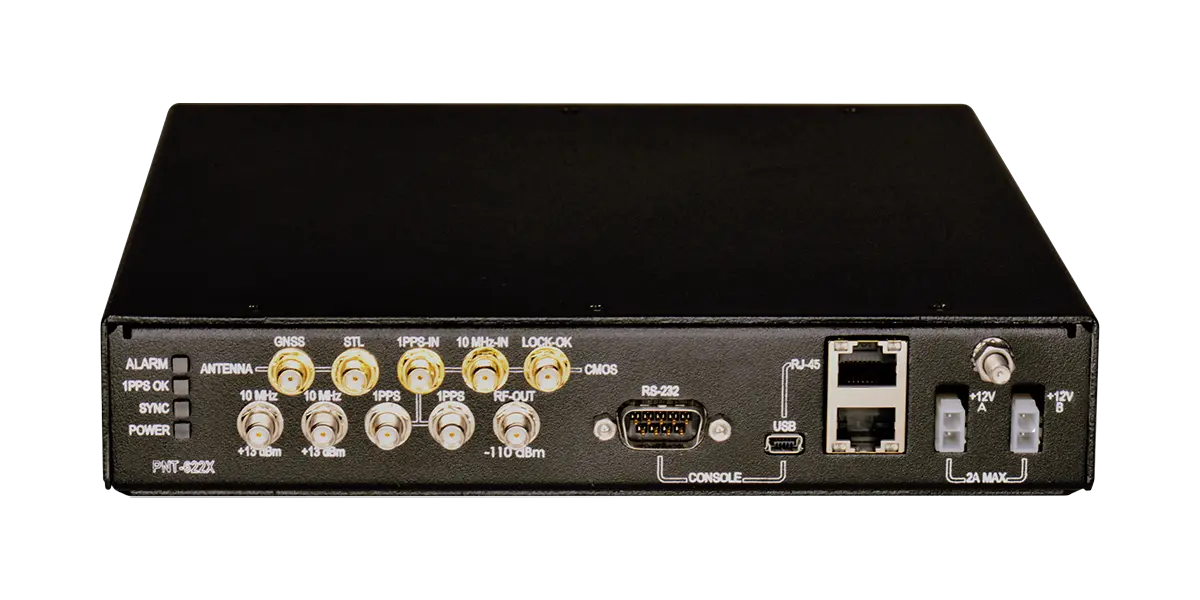
SecurePNT 6200 PNT-6250S Resilient PNT Clock with DOCXO Holdover and STL LEO Receiver
Resilient PNT clock and GPS transcoder with multi-frequency GNSS, LEO STL receiver and DOCXO holdover.
- 1 PPS stability, GPS/GNSS locked
- <5 ns RMS
- 1 PPS stability, altGNSS LEO locked
- <65 ns RMS altGNSS LEO locked to Iridium’s STL service
- Holdover performance
- <2 µs with DOCXO
Overview
The VIAVI SecurePNT 6200 series is a resilient timing reference built on TrustedPNT technology and a zero-trust multisource platform. Each unit combines a multi-frequency L1/L2/L3/L5 GNSS receiver supporting GEO satellite signals with an optional LEO Satellite Time and Location (STL) receiver, so timing and positioning remain available when GPS/GNSS signals are jammed, spoofed or unavailable. Holdover is provided by an internal DOCXO or rubidium oscillator, and external 10 MHz and 1 PPS inputs allow a cesium clock to be used as a holdover reference.
SecureTime services
The PNT-6250S works with VIAVI SecureTime services, which add alternative and enhanced timing sources on top of GPS/GNSS. altGNSS LEO is a GNSS-independent encrypted source powered by Iridium STL, traceable to UTC(NIST). eGNSS GEO is an enhanced GNSS source with authenticated spoofing detection and mitigation, powered by Fugro AtomiChron on Inmarsat. altGNSS GEO is a GNSS-independent source with authenticated spoofing detection and mitigation, traceable to NIST, powered by Fugro on Inmarsat and other satellite constellations.
Retrofitting legacy clocks
The patented µPNT Transcoder generates a GPS L1 C/A RF output signal, so the unit can be placed between the antenna and an existing GPS/GNSS clock to convert legacy equipment into a resilient PNT clock without replacing it. NMEA messages are available over USB and RS-232, and firmware is field-upgradeable through the same serial ports.
The half-19-inch rack-mountable unit meets the ITU-T G.8272 PRTC-A specification and is NEBS certified. Target users include network operators, data centers, financial transaction timing, deep-indoor timing and positioning, ship-board timing and R&D labs that need a GNSS-independent timing and positioning reference.
Key Features
- L1/2/3/5/6+PPP GNSS receiver supporting GEO satellite signals
- Optional LEO STL receiver
- Holdover options: DOCXO or Rb oscillator (internal)
- 10 MHz and 1 PPS inputs for external Cesium clock holdover
- 10 MHz and 1 PPS outputs
- Meets PRTC-A ITU-T G.8272 specification
- NEBS certified
- Half 19-inch width, rack-mountable
- Intelligent zero-trust multisource switchover between GNSS, STL LEO, GEO Sat, 10 MHz and 1 PPS
- Patented µPNT Transcoder outputs a GPS L1 C/A RF signal to retrofit legacy GPS/GNSS clock equipment
- SecureTime altGNSS LEO: GNSS-independent encrypted source, <65 ns RMS traceable to UTC(NIST), powered by Iridium STL
- SecureTime eGNSS GEO: enhanced GNSS source with authenticated spoofing detection/mitigation, <5 ns RMS, powered by Fugro AtomiChron on Inmarsat
- SecureTime altGNSS GEO: GNSS-independent source with authenticated spoofing detection/mitigation, <±100 ns peak-to-peak, traceable to NIST
- Augmented PNT clock for GPS/GNSS-denied or indoor environments
- Multi-frequency GNSS tracking of GPS, Galileo (SBAS), GLONASS, BeiDou, QZSS and NAVIC
- NMEA messages over USB and RS-232
- Fully field-upgradeable firmware through USB or RS-232 serial ports
- Single or dual redundant +12 V DC power inputs
Specifications
| 1 PPS stability, GPS/GNSS locked |
<5 ns RMS
Traceable to UTC/NIST
|
|---|---|
| 1 PPS stability, altGNSS LEO locked |
<65 ns RMS altGNSS LEO locked to Iridium’s STL service
Traceable to UTC/NIST; with LEO STL receiver
|
| Holdover performance |
<2 µs with DOCXO
Over 24 hours @ 25°C, no airflow, no motion; after 7 days with GNSS reference. Datasheet lists this for model 6250/6250S
|
| Transcoder output |
GPS L1 C/A RF output signal to retrofit legacy GPS/GNSS clock equipment
Patented multisource-to-GPS transcoder
|
|---|---|
| NMEA messages | USB and RS-232 connectors, GGA, RMC, ZDA, GSV, PASHR, GSA |
| Multifrequency | L1, L2, L3, L5 |
|---|---|
| Constellations | GPS/Galileo (SBAS)/GLONASS/BeiDou/QZSS/NAVIC |
| Acquisition (C/N0 threshold) |
33 dB-Hz
Tracking performance
|
| Tracking (C/N0 threshold) |
20 dB-Hz
Tracking performance
|
| TTF, cold start | <45 sec |
| TTF, warm start | <20 sec |
| TTF, reacquisition | 1 sec |
| GEO Sat signals | Integrated GEO receiver |
| Intelligent zero-trust multisource switchover | GNSS (4 frequencies), STL LEO, GEO Sat, 10 MHz, 1 PPS |
|---|
| External reference inputs for Cesium holdover clock | 10 MHz Sine Wave (0 dBm to +15 dBm), 1 PPS CMOS options |
|---|---|
| 1 PPS input | 1 x 1 PPS Input, SMA, >1 K Load |
| 10 MHz | 2x +13 dBm 10 MHz sine wave, low phase noise option |
|---|---|
| 10 MHz accuracy | <±0.2E-010 after 20 min with GNSS |
| 1 PPS | 2 x 1 PPS Outputs via SMA (Coax) (>1K Load), 3.3 V |
| Frequency |
10 MHz
DOCXO or Rb oscillator option
|
| Spurs | <-110 dBc/Hz |
| Oscillator |
DOCXO
From ordering description: Transcoder DOCXO GNSS-T STL ROHS
|
| Stability over temperature (holdover mode) | -10° to +75°C: ±0.2E-09 DOCXO option |
| Supply voltage (Vdd) | Single or Dual redundant +12 V DC inputs |
|---|---|
| Power consumption | <10 W (DOCXO variant) |
| Operating temperature range |
-25°C to +75°C
Forced air environment
|
|---|---|
| Storage temperature range | -45°C to +85°C |
| Size | Half 19” width, 1.64” x 8.53” x 8” (H x W x D) |
|---|---|
| Weight | 1.5 lbs |
| RF antenna (one for STL, one for GNSS) | SMA (antenna power enable controls on both ports) |
|---|---|
| 10 MHz in/out, 1 PPS in/out, TTL status | SMA |
| In situ firmware updates | Fully field upgradeable through USB or RS-232 serial ports |
| Compliance marks | CB: Scheme International Safety; CE: EU Safety and EMC; FCC: USA EMC; RCM: Australia/New Zealand EMC |
|---|---|
| Emissions | FCC Part 15 (Class A), ICES 003 (Class A), ETSI EN 300 386, CISPR 32, EN 55032, ETSI EN 303 413, ETSI EN 301 489-1, ETSI EN 301 489-19 |
| Immunity | ETSI EN 300 386, ETSI EN 301 489-1, ETSI EN 301 489-19, EN 61000-4-2 ESD, EN 61000-4-3 radiated immunity, EN 61000-4-4 EFT, EN 61000-4-5 surge, EN 61000-4-6 low frequency common immunity, EN 61000-3-2 harmonic emission, EN 61000-3-3 voltage fluctuations and flicker emissions, EN 61000-4-11 voltage dips and interruptions |
| Safety | IEC 62368-1, EN 62368-1 |
| Other | NEBS GR 1089-CORE |
| Directives | Safety Directive 2014/35/EU, EMC Directive 2014/30/EU, Radio Equipment Directive (RED) 2014/53/EU, RoHS Directive 2011/65/EU and the (EU) 2015/863 amendment |
| STL LEO receiver | A VIAVI leading edge design |
|---|---|
| Sensitivity | -100 dBm tracking |
| Product number | 22172902 |
|---|---|
| Description | PNT-6250S Transcoder DOCXO GNSS-T STL ROHS |
Specifications are taken from the manufacturer's documentation. See the datasheet for complete and current values.
Applications
- Retrofitting legacy GPS/GNSS clock equipment
- Critical infrastructure (Presidential Executive Order 13905)
- Timing reference for 5G equipment
- Enhanced Primary Reference Time Clock (ePRTC) referencing
- IEEE-1588 disciplined referencing
- Network operators and back-office timing
- Data centers
- Financial transaction timing
- Deep-indoor timing and positioning
- Ship-board timing
- R&D labs requiring a GNSS-independent reference
- Financial services
- Power utilities
- Industrial automation
- Logistics and transportation
- Telecommunications
- Emergency response
- Defense
Options & Accessories
| Option | Description |
|---|---|
| altGNSS LEO-S | SecureTime altGNSS LEO-S Service — SecureTime service option for the STL LEO receiver models |
Documents & Resources
Related Products
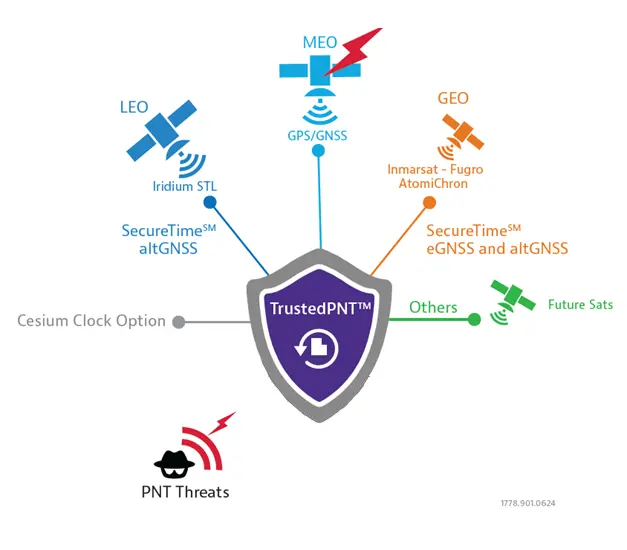
GEO satellite timing services offering GEO-enhanced GNSS (eGNSS) and alternate GNSS (altGNSS) timing sources independent of GNSS.
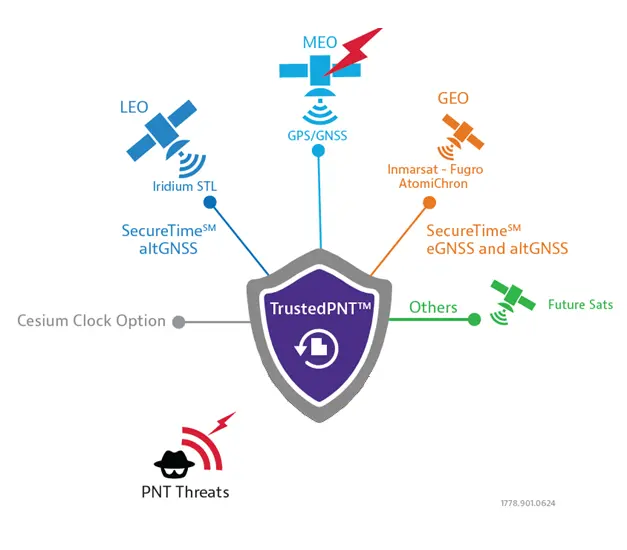
An alternate PNT service that uses Iridium LEO satellites to deliver encrypted, GNSS-independent positioning and timing.