VIAVI Signal Workshop RF Signal Creation, Capture and Analysis Software Suite
Software suite for RF waveform creation, playback, live signal capture and post-capture analysis with VIAVI CMP hardware.
- Modulation Types
- AM, AM suppressed carrier, AM signal-sideband - Upper / lower, with definable sideband bandwidth, FM, PM
- Baseband
- Up to 2 analog modulation tones, or .wav import
Overview
Signal Workshop is an integrated software suite from VIAVI for waveform creation, signal generation, signal capture and post-capture analysis. It is intended for finding and solving RF communications signal quality, spectral monitoring, interference and environmental RF issues.
Used with the VIAVI Configurable Modular Platform (CMP) system and/or the Software Communications Architecture (SCA) Development Suite, it operates as a general-purpose RF tool combining live and off-line signal simulation and analysis. Target applications include communications (SigInt, satellite), pulse (radar, EW), over-the-air (OTA) testing and electromagnetic environment (EME) characterization.
Software components
The Vector Signal Simulator (VSS) creates single waveforms or reproduces entire spectral environments, including mixed signals, realistic impairments and additive recorded signals. VSS computes the RF spectrum and Complementary Cumulative Distribution Function (CCDF) of created signals. Signal files are stored as a paired .txt text file and .dat data file.
The Vector Signal Player (VSP) provides the hardware interface for waveform playback on the AXIe-based CMP hardware, allowing signals to be played back at any frequency within the hardware's range and providing level control.
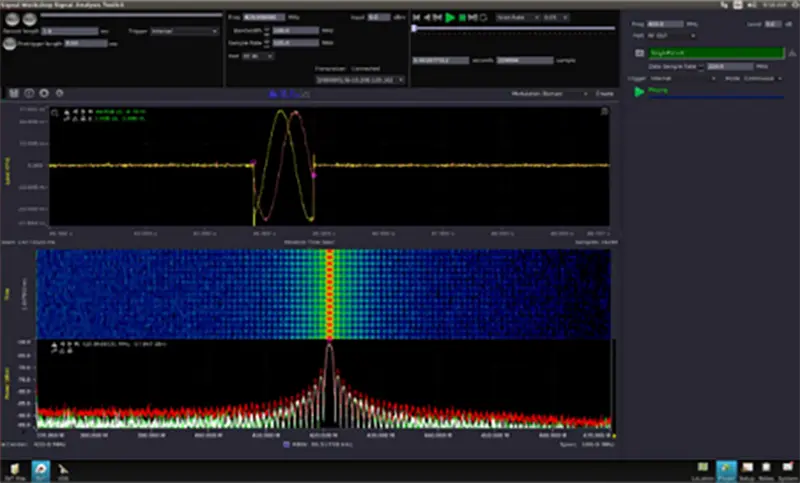
The Signal Vector Toolkit (SVT) captures live spectral environments in combination with CMP hardware, while SVT File provides post-capture analysis of saved files. Both share the same analysis functions, including spectrum/spectrogram/time plots, modulation domain analysis, analog and digital demodulation, burst analysis, pulse analysis, channel power, ACPR, environmental signal parameterization and a Spectrum Allocation Table. Captures can be trimmed in time and resampled to a custom bandwidth to manage file size.
Key Features
- Extensive RF analysis tool to characterize the spectrum environment or the performance of RF systems
- Live monitoring and capture of wideband RF signals
- Vector Signal Simulator (VSS) to create arbitrary waveforms
- Vector Signal Player (VSP) to play back captured or generated signals
- Live monitoring and post-capture signal display, analysis and processing
- Interactive spectrum / spectrogram / time plots
- Results strip charting and data logging
- Modulation domain analysis with basic modulation classification (AM, FM, CW, pulse, other)
- Precision GPS latitude, longitude, time stamp
- Bandwidth resampling engine and time-trim tools for capture file-size management
- AM / FM / PM analysis
- ASK / FSK / PSK / QAM analysis
- ASK Burst / FSK Burst / PSK Burst analysis
- Pulse analysis
- Signal notepad for recording plots and data
- Channel Power and Adjacent Channel Power Ratio (ACPR) analysis functions
- Spectrum Allocation Table (SAT)
- Environmental Signal Parameterization identifies and measures parameters for signals in the environment
- Remote API control
Specifications
| Modulation Types | AM, AM suppressed carrier, AM signal-sideband - Upper / lower, with definable sideband bandwidth, FM, PM |
|---|---|
| Baseband | Up to 2 analog modulation tones, or .wav import |
| Cell Technologies | WCDMA, CDMA2000, GSM, IS95 |
|---|---|
| Generic Digital Modulation – FSK | BPSK to 512 FSK |
| Generic Digital Modulation – PSK | up to 256 PSK |
| Generic Digital Modulation – QAM |
up to 1024
Modulation types include square nQAM (4 - 1024), nPSK (2 - 256), OQPSK, and Pi/r DQPSK
|
| Generic Digital Modulation – ASK | ASK |
| Number of Pulses | User-definable |
|---|---|
| Pulse Configuration | User-definable |
| Manual | Pulse width, Pulse interval, Transition (Step / Interval / Raised Cosine), Rise Time, Fall Time |
| File | Pulse descriptor file for irregular pulse configurations |
| Modulation On Pulse (MOP) | Barker, Bits, Symbols (BPSK, BFSK, OOK) |
| Frequency | Linear FM (chirp) |
| Additive White Gaussian Noise (AWGN) | Features include Bandwidth, Noise Seed, Duration |
|---|---|
| Noise Power Ratio (NPR) | Pedestal Width, Frequency Accuracy, Phase Seed, User-definable Notches |
| Tone Comb | Standard, Phase Modulated |
| Carrier Frequency |
User-definable, Carrier Plan: Absolute or Relative
Actual carrier frequency may be redefined at time of playback in VSP
|
|---|---|
| Start delay | User-definable |
| Impairments | Filter - superimposes user defined filter on complete waveform; Phase - user defined phase impairments |
| Multi-carrier / RF environment | VSS includes a remixing engine that automatically re-samples the composite mix, allowing multi-standard signal mixing |
| Hop | Frequency Start / Stop / Spacing, Dwell Time, Hop Sequence - random / file / sweep, Assignable frequency gaps |
| Import – I/Q |
Interleaved binary, twos complement, signed integer with either one or two bytes per sample
If two-byte samples are used, endian format must be known
|
| Import – Real |
Binary, twos complement, signed integer with either one or two bytes per sample
If two-byte samples are used, endian format must be known
|
| Monitor Mode |
Alternates between capture and post-capture analysis features
Results may not be contiguous
|
|---|---|
| Capture Mode |
Provides uninterrupted (contiguous) capture
Analysis is provided on an as-available basis, similar to monitor function
|
| Controls | Center Frequency, Capture Bandwidth, Capture Mode - Normal (offset), or Zero IF, Input Level, Port, IP Address, Play, Stop, Rewind, Step Forward, Step Reverse |
| Scan Rate | playback can be sped up or slowed down, or movement may be measured in time or samples |
| Main Displays | FTT, Time, Spectrogram (Waterfall), Strip Chart |
|---|---|
| Analog Demodulation (AM / FM / PM) | Includes AM USB, LSB, and suppressed carrier |
| Digital Demodulation Types | LTE Downlink, ASK, ASK Burst, FSK, FSK Burst, PSK / QAM, PSK / QAM Burst, PSK / QAM Est, PSK / QAM Gain / Phase |
| ASK | BASK, OOK, 4ASK, Bit level demodulation |
| FSK |
MSK, BFSK, 4FSK, Bit level demodulation
Datasheet prints 'Bit leve demodulation'
|
| PSK / QAM |
BPSK, OQPSK, pi/4, DQPSK, (8, 16, 32, 64, 128, 256) PSK, (4, 16, 32, 64, 128, 256, 512, 1024) QAM
Rectangular or Root Raised Cosine measurement filter; includes eye plot and eye closure measurements, as well as bit level demodulation
|
| PSK / QAM Est | PSK / QAM Estimator |
| PSK / QAM Gain / Phase | Gain / Phase / Group Delay |
| Channel Power | User-definable list |
| Environmental Parameterization | Modulation estimation tool |
| High Resolution Spectrum Analyzer | Tunable for focused analysis within capture band |
| Pulse | Carrier, Frequency, power, pulse width, PRI and modulation characteristics (chirp, Barker, etc.), rise and fall times, Doppler, TOA, time rate of change over time, and more. |
| Signal Allocation Table (SAT) | Provides a pre-definable table of frequency definitions, useful for monitoring / quickly identifying frequencies of interest. |
| Import – I/Q |
Interleaved binary, twos complement, signed integer with either one or two bytes per sample
If two-byte samples are used, endian format must be known
|
| Import – Real |
Binary, twos complement, signed integer with either one or two bytes per sample
If two-byte samples are used, endian format must be known
|
| Import – Multi-Channel |
Interleaved binary, twos complement, signed integer with either one or two bytes per sample
If two-byte samples are used, endian format must be known; actual limitations are dependent on hardware
|
|
Instantaneous bandwidth
mA-6806
|
up to 200 MHz
Generation and capture on AXIe-based VIAVI CMP hardware
|
|---|---|
|
Carrier frequency
mA-6806
|
up to 6 GHz |
|
Onboard capture
mA-6806
|
up to 500 M samples |
|
RAID streaming storage
mA-3A01
|
up to 9.6 TB
Over 2.5 hours of continuous recording or playback at full bandwidth
|
Specifications are taken from the manufacturer's documentation. See the datasheet for complete and current values.
Applications
- Communications signal intelligence (SigInt)
- Satellite communications
- Radar pulse analysis
- Electronic warfare (EW)
- Over-the-air (OTA) testing
- Electromagnetic environment (EME) characterization
- Spectrum monitoring and management
- RF interference analysis
- Avionics pulse analysis such as DME