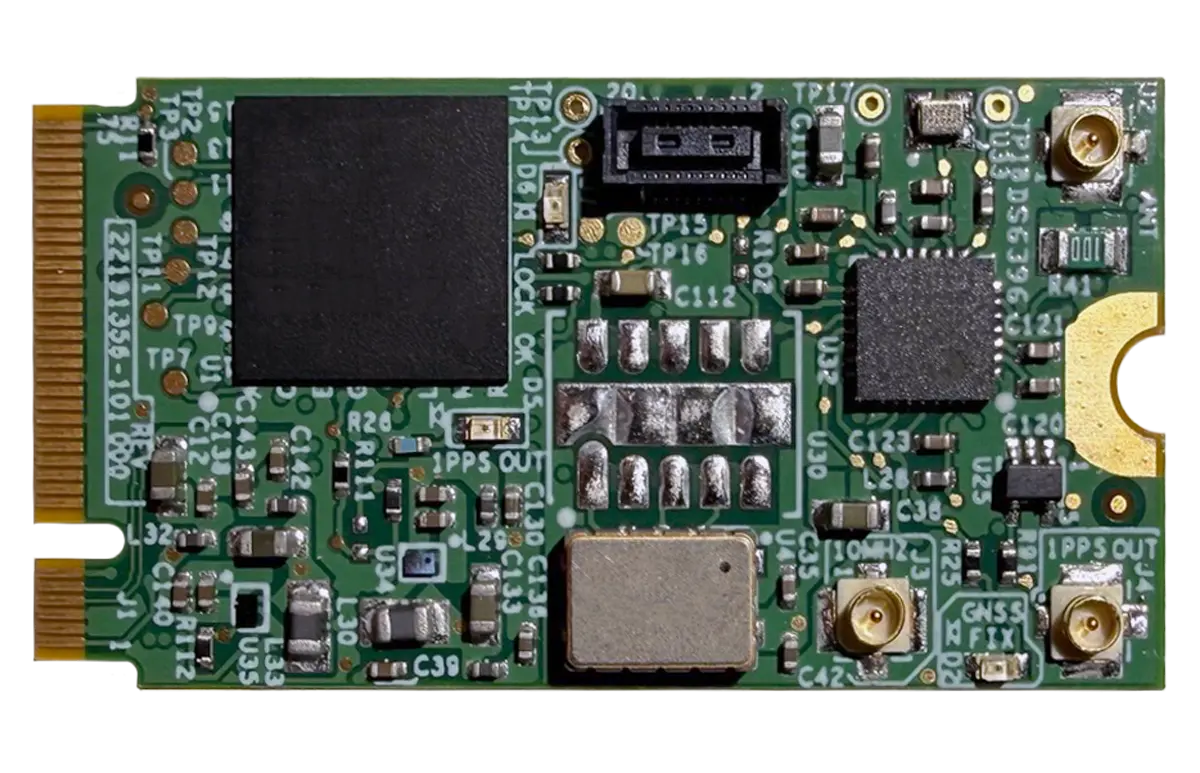
VIAVI MicroPNT GDO-1000 Dual-Frequency L1/L5 GNSS Timing Module in M.2 B-key Form Factor
Compact M.2 B-key GNSS timing module with dual-frequency L1/L5 reception and microsecond-class 24-hour holdover from a MEMS-based oscillator.
- GNSS reception
- Dual-frequency L1/L5
- Holdover
- microsecond-class 24-hour holdover
Overview
The VIAVI µPNT GDO-1000 is a precision timing module in a small, low-power package. It combines dual-frequency L1/L5 GNSS reception with a MEMS-based oscillator that provides microsecond-class holdover over 24 hours, so timing can continue when GNSS signals are degraded or unavailable.
The module targets defense and critical infrastructure applications, where GNSS interference is an ongoing operational concern and dual-frequency L1/L5 reception is increasingly specified as a baseline requirement. Its size and power draw suit platforms with tight payload limits, such as dismounted and unmanned systems. It is also an alternative for designs that have used chip-scale atomic clocks (CSACs).
Form factor and integration
The GDO-1000 uses the M.2 B-key form factor. It fits into compute platforms, time appliance cards and embedded systems without custom mechanical design and draws approximately half a watt. Several 1PPS and low-phase-noise 10MHz coaxial inputs and outputs are provided for system integration. An external 1PPS input lets the module be disciplined by M-Code GPS, alternative navigation sources or other external references without hardware modification.
Oscillator and algorithms
The MEMS oscillator offers better thermal stability across the full military temperature range than traditional quartz OCXOs. According to VIAVI, phase noise and Allan Deviation performance hold up under vibration and shock. Patented AI and ML algorithms, developed by the Jackson Labs team that is now part of VIAVI, predict and compensate for oscillator behavior across environmental conditions.
Key Features
- Dual-frequency L1/L5 GNSS reception
- Microsecond-class 24-hour holdover from a MEMS-based oscillator
- M.2 B-key form factor for compute platforms, time appliance cards and embedded systems
- Power draw of approximately half a watt
- Patented AI and ML algorithms that predict and compensate for oscillator behavior across environmental conditions
- MEMS oscillator with better thermal stability across the full military temperature range than quartz OCXOs
- Sustained phase noise and Allan Deviation performance under vibration and shock
- External 1PPS input for disciplining by M-Code GPS, alternative navigation sources or other external references
- Multiple 1PPS and low-phase-noise 10MHz coaxial inputs and outputs
Specifications
| GNSS reception | Dual-frequency L1/L5 |
|---|---|
| Holdover |
microsecond-class 24-hour holdover
From MEMS-based oscillator
|
| Oscillator type | MEMS (Micro-Electro-Mechanical Systems) |
|---|
| Timing inputs/outputs | Multiple 1PPS and low-phase-noise 10MHz coaxial inputs and outputs |
|---|---|
| External reference input |
External 1PPS input
Allows disciplining by M-Code GPS, alternative navigation sources or other external references
|
| Form factor | M.2 B-key |
|---|
| Power consumption | approximately half a watt |
|---|
Applications
- Defense timing systems
- Critical infrastructure timing
- Unmanned platforms
- Warfighter-carried equipment
- Embedded systems
- Time appliance cards
- CSAC replacement designs