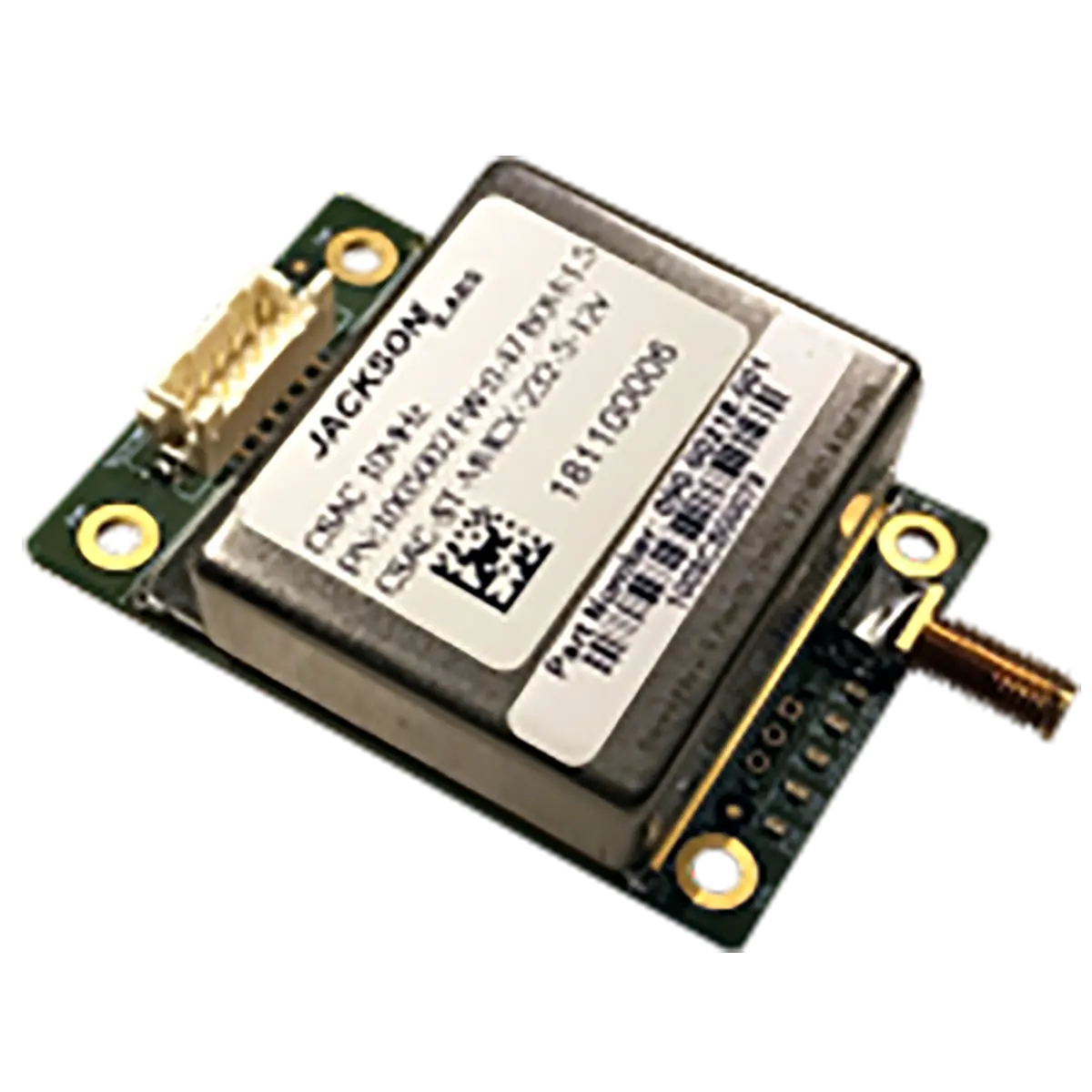
RSR GNSS Transcoder and GPS Full-Constellation Simulator
Compact module that converts NMEA/SCPI position, velocity and time data into a real-time L1 GPS RF signal for legacy GPS receivers.
- Data/power connectors
- Mini-USB for power and SCPI, 12-pin 2 mm Hirose for power and external GNSS
- Timing outputs
- One 3 V CMOS 1 PPS output, one 10 MHz CMOS 3 V DC output
- RF output
- One RF SMA, GPS L1 C/A code, -100 to -120 dBm
- Spectral purity
- < -33 dBc in-band (L1, ±20 MHz), < -80 dBm out-of-band
Overview
The VIAVI RSR GNSS Transcoder is based on VIAVI GPS simulator technology. It lets existing GPS equipment be retrofitted to support next-generation GNSS, SAASM, M-Code, INS and other PVT/PNT sources. It can also be used as a small general-purpose GPS simulator for testing, manufacturing, qualification, spoofing and jamming simulation. The module measures 1.6 x 2.3 inches, needs no external computer, consumes less than 1.1 W, can be mounted directly below a Rockwell Collins RSR SAASM Puck receiver, and offers optional CSAC holdover.
Operating principle
The Transcoder takes NMEA or SCPI baseband position, velocity and time information and converts it within milliseconds into a matching L1 GPS RF signal. To the legacy target receiver, this signal looks like a standard live-sky GPS signal. A modern GNSS receiver (GPS with SBAS, Galileo, GLONASS, BeiDou, SAASM, M-code) can therefore feed the integrated full-constellation GPS simulator, which outputs a legacy GPS RF signal in real time. The legacy system is upgraded by replacing only the GPS antenna with the Transcoder. The unit also includes a real-time INS, and an optional CSAC atomic clock provides holdover during GNSS-denied operation.
Power and interfaces
The Transcoder can be powered and controlled from a standard USB port, or from an optional vehicle/avionics power supply covering 7 V to 36 V. Integral RS-232 ports connect to an external GNSS receiver or another NMEA source. An external 1PPS input gives 5 ns time-transfer accuracy to the RF signal. The GPS L1 RF output connector has an integrated antenna load for receivers that need a DC antenna load to operate properly.
Software
External GNSS receivers, such as Rockwell SAASM receivers and u-blox GNSS receivers, are detected and configured automatically over the RS-232 port. The module can be monitored, programmed, controlled and adjusted over USB using the freeware SimCon application, GPSCon, or any standard serial terminal.
Key Features
- Embedded NMEA transcoding to L1 GPS in real time
- Upgrades existing GPS to GNSS, SAASM, M-Code, INS
- Optional CSAC holdover capability
- 1.6 x 2.3 x 0.5 inches, 1.1 W
- Low-cost general-purpose GPS simulation
- GPS spoofing and jamming simulation
- USB and RS-232 interfaces
- 5 V USB, or 7 V to 36 V DC power
- Form, fit, function compatible with the Rockwell Collins RSR SAASM Puck
- GPS week number roll-over simulation or offsetting to bypass legacy GPS bugs
- Leap second simulation
- High-dynamics simulation
- 5 ns timing and sub 1 m positioning accuracy typically
- Integrated real-time INS
- Automatic detection and configuration of Rockwell SAASM and u-blox GNSS receivers
Specifications
| Data/power connectors | Mini-USB for power and SCPI, 12-pin 2 mm Hirose for power and external GNSS |
|---|---|
| Timing outputs |
One 3 V CMOS 1 PPS output, one 10 MHz CMOS 3 V DC output
Disciplined by external 1 PPS reference or internal CSAC
|
| RF output |
One RF SMA, GPS L1 C/A code, -100 to -120 dBm
The web page gives the output as -120 dBm L1; the datasheet range is used here
|
| Spectral purity |
< -33 dBc in-band (L1, ±20 MHz), < -80 dBm out-of-band
1 MHz to 13.2 GHz
|
| Harmonics of L1 (1.57542 GHz) | < -150 dBm |
| External 1PPS time-transfer accuracy |
5ns
Time-transfer accuracy to the RF signal
|
| Timing and positioning accuracy |
5 ns timing and sub 1 m positioning-accuracy
typically
|
| CSAC holdover |
< 1 µs/24 hrs
typical @ 25°C with ±5°C change after 48 Hrs with stable 1 PPS UTC reference input
|
| USB control | SCPI-99 Control at 9.6 K, 19.2 K, 38.4 K, 57.6 K, 115.2 K |
|---|---|
| External GNSS receiver compatibility | Any NMEA compatible source, direct control of Rockwell Collins GB-GRAM and MicroGRAM SAASM GPS, and u-Blox GNSS receivers |
| USB SCPI control/monitoring port | Compatible to any terminal program and GPSCon, NMEA output sentences |
| Power supply | 5 V USB, or 7 V to 36 V DC power |
|---|---|
| Power consumption | 1.1 W |
| Dimensions | 1.6 x 2.3 x 0.5 inches |
| Operating temperature | -40°C to +75°C with TCXO, -10 to +70°C with CSAC |
|---|---|
| MTBF |
> 600,000 Hours
with TCXO
|
Specifications are taken from the manufacturer's documentation. See the datasheet for complete and current values.
Applications
- Retrofitting legacy GPS equipment to modern GNSS
- GPS receiver testing
- Manufacturing test
- Qualification testing
- GPS spoofing and jamming simulation
- Defense
- 5G communications
- SATCOM
- Transportation
- Data center
- Energy
- Financial
- Critical infrastructure
Options & Accessories
| Option | Description |
|---|---|
| 1005123 | RSR Transcoder w/CSAC - non-RoHS |
| 1005124 | RSR Transcoder w/o CSAC - non-RoHS |
| 22174894 | RSR Transcoder w/o CSAC - RoHS |
| 1005127 | RSR Transcoder w/o CSAC w/IP67 Encl - non-RoHS |
| 1005128 | RSR Transcoder w/CSAC IP67 ENCL - non-RoHS |
| 1005133 | RSR Transcoder w/CSAC and MCX connector - non-RoHS |
| 1005173 | RSR Transcoder w/TCSAC and MCX connector - non-RoHS |
| 1005178 | RSR Transcoder w/TCSAC IP67 w/Encl - non-RoHS |
| 1005193 | RSR Transcoder w/TCSAC - non-RoHS |
| 22174898 | RSR Transcoder w/o CSAC w/MCX Connector - RoHS |