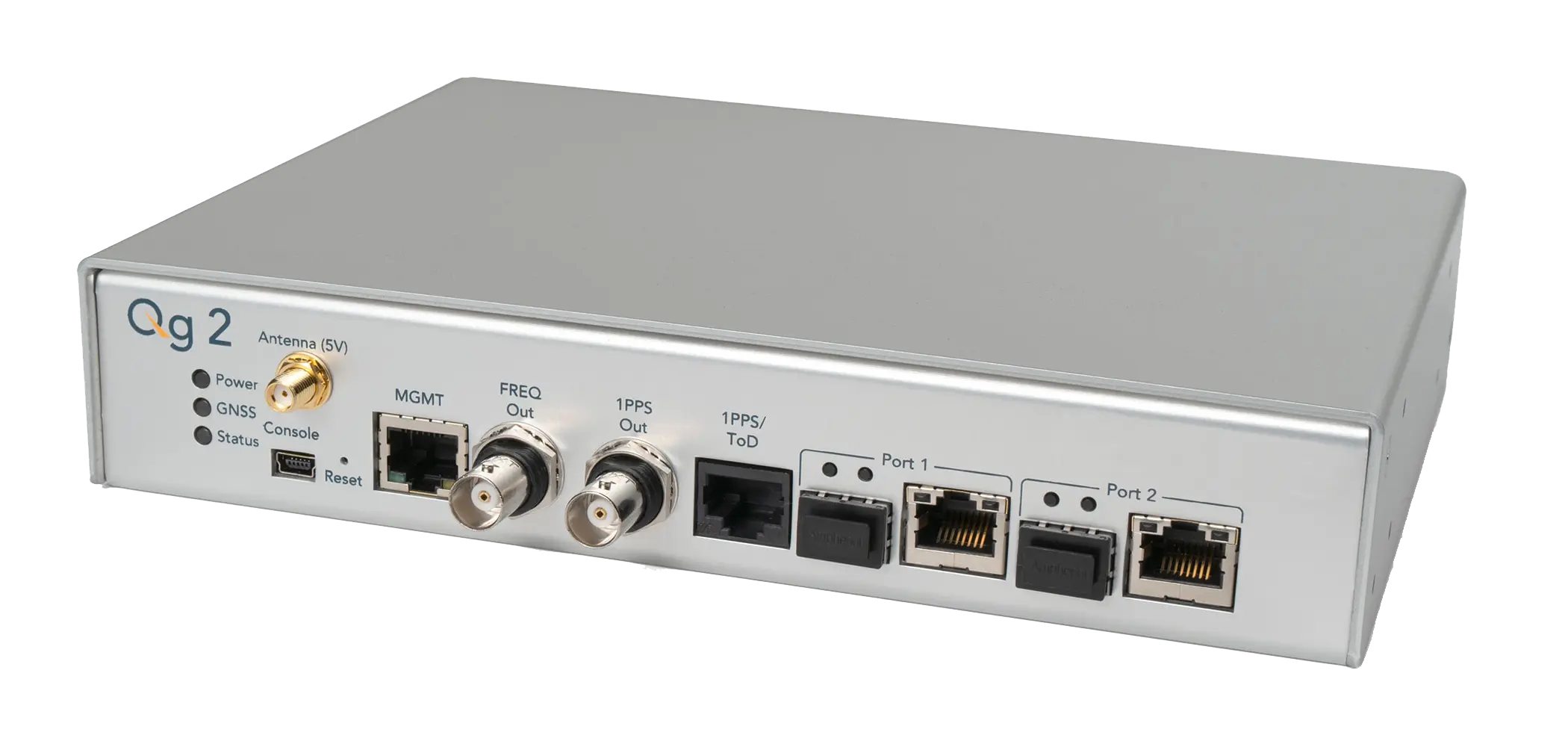
VIAVI Qg 2 Multi-Sync Gateway and PTP Grandmaster
Compact IEEE 1588-2008 PTP grandmaster and boundary clock with GNSS, PTP and SyncE inputs for 5G, O-RAN, data center and smart grid timing.
- PTP
- IEEE 1588-2008 (PTP) Grandmaster and Boundary Clock
- Telecom profiles
- ITU-T G.8265.1 Frequency, ITU-T G.8275.1 and G.8275.2 Time and Phase Profiles
- Clock performance standards
- ITU-T G.8272 and G.8273.2 (T-BC)
- Synchronous Ethernet
- G.8262
Overview
The VIAVI Qg 2 is a multi-sync gateway that provides synchronization through IEEE 1588-2008 (PTP), using multiple sync references. It offers PTP Grandmaster and Boundary Clock functionality in a small-footprint, indoor unit and can be configured to operate as a PTP Grandmaster, boundary clock or slave clock.
As 5G moves from non-standalone (NSA) to standalone (SA) architecture, massive MIMO radios, network slicing, low latency and tight synchronization place stricter phase and frequency requirements on the network. Deploying more grandmasters (PRTC) in the RAN and at the edge addresses these requirements. With the virtualization and decomposition of 4G/5G base stations, data centers and CORDs (Central Office Re-architected as Data Centers) also need a scalable PTP master (T-GM, T-BC) able to synchronize hundreds of PTP slave devices.
The Qg 2 uses VIAVI PTP algorithms to deliver timing for LTE-A, LTE-TDD, CBRS (USA), SxGP (Japan), private LTE and operator or private 5G architectures, and supports the ITU-T G.8265 and G.8275 frequency and phase profiles. Multiple oscillator options are available to provide a range of holdover performance when reference sources are lost.
Inputs and outputs
The unit uses GNSS (GPS, Beidou, GLONASS, QZSS and Galileo) to receive and display both timing and location information, and also accepts PTP and Synchronous Ethernet as input references. It generates PTP, SyncE and timing signals (frequency, 1 PPS and ToD) as outputs. Dual 1 GbE ports support both copper RJ45 and optical connections, and the timing interfaces include GNSS, 1 PPS, Time of Day (input/output) and programmable frequency output.
Management
The Qg 2 supports remote provisioning and management through CLI, HTTP(S) and SNMP. Position and location information can support SAS and other location-based services.
Key Features
- Multiple holdover options
- Full IEEE 1588-2008 (PTP) Grandmaster
- Telecom BC functionality
- Supports G.8262 Synchronous Ethernet
- ITU-T G.8265.1 Frequency, ITU-T G.8275.1 and G.8275.2 Time and Phase Profiles
- ITU-T G.8272 and G.8273.2 (T-BC)
- IEEE PC37.238 Power profile
- Supports 1-step and 2-step clock
- -48V DC power
- SNTP (NTP Stratum 1) Server
- Remote provisioning and management (CLI, HTTP(S) and SNMP)
- Receives and displays both time and location information from GNSS
- Small form-factor, designed for indoor deployments
- Highly scalable slave capacity
- Low power consumption
- Configurable to operate as PTP Grandmaster, boundary or slave clock
- Position and location information to aid SAS and other location-based services
Specifications
| PTP | IEEE 1588-2008 (PTP) Grandmaster and Boundary Clock |
|---|---|
| Telecom profiles | ITU-T G.8265.1 Frequency, ITU-T G.8275.1 and G.8275.2 Time and Phase Profiles |
| Clock performance standards | ITU-T G.8272 and G.8273.2 (T-BC) |
| Synchronous Ethernet | G.8262 |
| Power profile | IEEE PC37.238 |
| Clock mode | 1-step and 2-step |
| NTP | SNTP (NTP Stratum 1) Server |
| GNSS constellations | GPS, Beidou, GLONASS, QZSS and Galileo |
|---|---|
| Input references | GNSS, PTP and Synchronous Ethernet |
| Outputs | PTP, SyncE and timing signals (frequency, 1 PPS and ToD) |
| Ethernet ports | Dual 1 GbE ports for both copper RJ45 and optical connections |
| Timing interfaces | GNSS, 1 PPS, ToD (input/output), frequency (programmable output) |
| Remote management | CLI, HTTP(S) and SNMP |
|---|
| Power supply | -48V DC |
|---|
Applications
- 5G, Open RAN, small cell clusters, C-RAN and neutral host deployments
- S-plane LLS C1 - C4 5G O-RAN configurations
- RU/DU/CU functional splits in the RAN and edge
- Smart grid transmission and distribution substations
- Mobile edge computing and enterprise
- Industrial IoT and factory automation
- Data centers and financial applications
- LTE-A, LTE-TDD, CBRS and SxGP timing
- Private LTE and private 5G networks