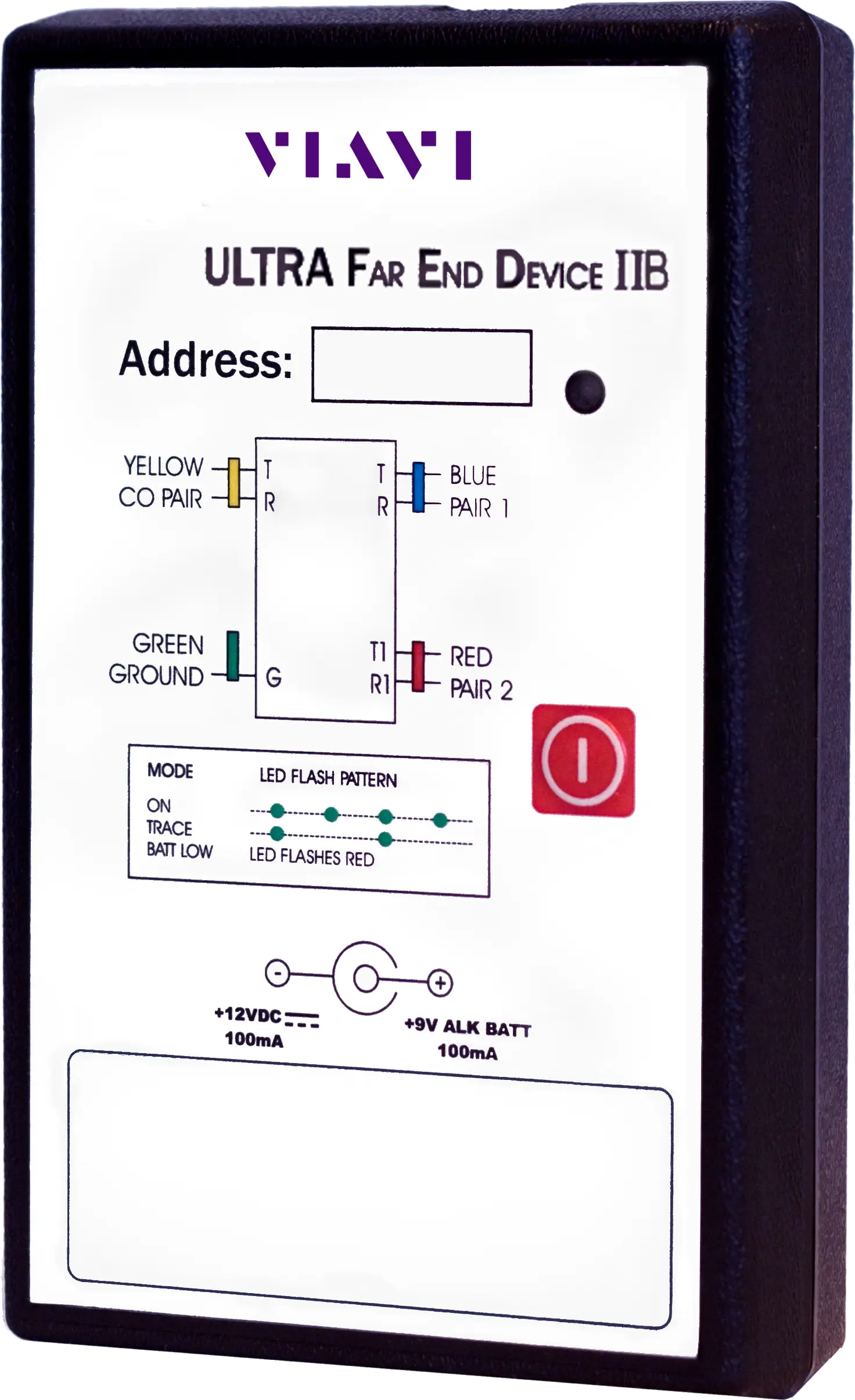
VIAVI UltraFED IIB 30 MHz Far-End Device for Dual-Ended Copper and DSL Testing
Remote far-end device for dual-ended testing of single and bonded pair VDSL2 and ADSL2+ copper circuits from POTS to 30 MHz.
- Size
- 152 x 101 x 38 mm (6 x 4 x 1.6 in)
- Weight
- 226.80 g (8 oz)
- Battery life
- 20 hours of continuous use
- Battery shelf life
- 2 months installed (20 hours of continuous use)
Overview
The VIAVI UltraFED IIB is a far-end device for dual-ended testing of copper pairs. It connects to the far end of the pair under test while a single technician controls it remotely from a companion test set (the ONX-580 or HST-3000) using DTMF tones, so one technician with one instrument can perform two-ended pair testing during turn-up, installation and routine troubleshooting.
The device provides remote line terminations and test conditions, including strap (short), open, drop battery, transmit tones and trace tones, and covers frequencies from POTS (200 Hz) to VDSL2 (30 MHz). This removes the need to drive to the far end to change line conditions and helps isolate faults that single-ended testing can miss on higher-bandwidth circuits such as VDSL2.
Bonded pair testing
By terminating a second pair, the UltraFED IIB allows the companion test set to measure near-end crosstalk (NEXT) and far-end crosstalk (FEXT) between bonded VDSL2/ADSL2+ pairs before provisioning, reducing pair swapping and repeat dispatches.
Operating modes and diagnostics
The UltraFED IIB operates in passive mode, where the test set activates it remotely for dual-ended testing, and in through mode, where it activates automatically as needed so customers are taken out of service only when necessary. The OneCheck Copper test suite runs automated diagnostics to the UltraFED IIB, and the TDR Helper function alternately opens and shorts the pair to help identify the pair end on a TDR trace.
Key Features
- Dual-ended copper testing controlled remotely by a single technician
- Remote strap (short), open, drop-battery, transmit tones and trace tone
- Supports frequency ranges from POTS (200 Hz) to VDSL2 (30 MHz)
- Second-pair operation to assess near-end and far-end crosstalk
- Crosstalk tests for VDSL2 and ADSL2+ bonded pairs
- Through-mode operation takes customers out of service only when necessary
- Both manual and automated operation modes
- TDR Helper automatically shorts and opens the pair to identify pair endings
- Command mode lets technicians start and stop tests during execution
- OneCheck diagnostics identify faults up to three times faster
- Eliminates driving to change line conditions
Specifications
| Size | 152 x 101 x 38 mm (6 x 4 x 1.6 in) |
|---|---|
| Weight | 226.80 g (8 oz) |
| Battery life | 20 hours of continuous use |
| Battery shelf life | 2 months installed (20 hours of continuous use) |
| Operating temperature range |
–18 to –60°C (–0 to 140°F)
As printed in the datasheet; the Celsius and Fahrenheit figures do not match
|
|---|---|
| Storage temperature range |
–40 to –75°C (–40 to 165°F)
As printed in the datasheet; the Celsius and Fahrenheit figures do not match
|
| Humidity range | 10 to 95% RH noncondensing |
| Tone transmit | 200 Hz to 30 MHz ±0.015% at 0 dBm; trace tone (2 cadences) |
|---|---|
| Voiceband (POTS) frequency range | 200 Hz to 20 kHz/600 Ω |
| Wideband (xDSL) frequency range | 10 kHz to 30 MHz/100 Ω |
| Single Tone | Connects a tone generator across tip (A) to ring (B) to measure loss |
|---|---|
| Trace Tone 1 | Connects a tone generator across tip (A) to ring (B) and sends 577 and 1004 Hz tones at cadence 1 |
| Trace Tone 2 | Connects a tone generator across tip (A) to ring (B) and sends 577 and 1004 Hz tones at cadence 2 |
| Balance Single Tone | Connects a tone from tip (A) to ring (B) to ground to assess line balance in the xDSL frequency range |
| Quiet Termination | Terminates the pair at the FED |
| Open All | Disconnects tip (A), ring (B), and ground (sleeve) from the cable pairs to isolate the pair under test |
| Tip-Ring Short | Also called strap mode. Connects tip (A) to ring (B) and is used with loop resistance or RFL measurements |
| Tip-Ring-Gnd Short | Connects tip (A), ring (B), and ground (sleeve) to ground and is used while measuring resistive balance |
| RFL 3-Way Strap | Connects tip (A) to T1 to ring (B) and is used primarily for measuring RFL on a verified good pair |
| TDR Helper | Continuously opens and shorts the pair to identify the pair's end |
| Off/Thru | Connects tip (A) and ring (B) to the CO tip (A) and ring (B) to maintain "in-service" customer connection and "out-of-service" as necessary during test |
Specifications are taken from the manufacturer's documentation. See the datasheet for complete and current values.
Applications
- VDSL2 and ADSL2+ circuit installation and turn-up
- Bonded pair qualification and fault isolation
- NEXT and FEXT crosstalk assessment
- Copper pair troubleshooting
- Pair end identification with TDR Helper
- Series fault detection from splice failures
- Bridged tap detection with distance and length
- Pair length measurement (OneCheck TrueLength)
- Resistive fault pretest (OneCheck RFL Pretest)
- Shield resistance testing
- Legacy HDSL and POTS line testing
Included
- User guide
- Soft cover glove
Options & Accessories
| Option | Description |
|---|---|
| UFEDIIB | UltraFED IIB, user guide and soft cover glove |
| UFEDIIB-PKG1 | UltraFED IIB, user guide, soft cover glove and cables |
| ULTRAFED-CB-BON | UltraFED cable RJ45 to 7 clip leads (bed of nails) |
| ULTRAFED-CB-PROT | Lightning protection cable |
| ULTRAFED-CB-RTC | UltraFED cable RJ45 to clip leads |
| ULTRAFED-CB-SAFE | UltraFED cable RJ45 to 4 mm safety |
| ULTRAFED-GLOVE | UltraFED glove |
| ULTRAFED-AC-ADAPTER | AC adapter for the UltraFED |
| CB-4MMCLP7-BON | 4 mm bed of nail clips (package of 7) |
| ULTRAFED-ML | UltraFED manual |