VIAVI Medusa Labs Test Tools (MLTT) Suite Data Integrity, Benchmarking and Stress-Test Software
Application-based data integrity, benchmarking and stress-test software for storage, SAN/LAN and converged network equipment development.
- Recommended processor
- 2 GHz processor, or better
- Recommended memory
- at least 1 GB RAM
- Multiprocessor support
- Can take full advantage of multiple processors when available
Overview
The VIAVI Medusa Labs Test Tool (MLTT) Suite is application-based data- and signal-integrity test software for companies developing servers, switches, host bus adapters (HBAs), PCIe interfaces, converged network adapters (CNAs), solid-state storage (SSD), NVMe devices, all-flash arrays (AFA) and other storage equipment for converged storage networks.
MLTT supports design validation, system bring-up and quality assurance testing with a set of data integrity, benchmarking and stress-test tools. It helps uncover data-corruption errors, device and system data-pattern sensitivities, I/O timeouts, I/O losses and system lockup scenarios. The software is designed to use as little CPU overhead as possible so that devices under test can run at their optimal rates.
Converged SAN and LAN testing
MLTT provides storage and TCP application tests for unified storage area network (SAN) and local area network (LAN) applications. Test cases can simulate TCP applications such as file server, Exchange server, HTTP, Oracle and SIP, and a coordinated TCP burst mode can be used to induce TCP incast conditions. Protocol-specific data patterns cover standards including Fibre Channel, FCoE, iSCSI, PCIe, NVMe, SAS, SATA, SSD and Ethernet.
SSD and NVMe testing
Because SSD performance tends to start high and level out over time, MLTT includes a configurable steady-state detection feature that establishes stable performance before benchmark testing. Several erase methods for ATA-, SCSI- and NVMe-attached devices return devices to a known, factory-fresh state prior to testing. T10 Protection Information (T10-PI) formats, journal-and-verify logging, and configurable compression and de-duplication data patterns are also supported.
Automation and analysis
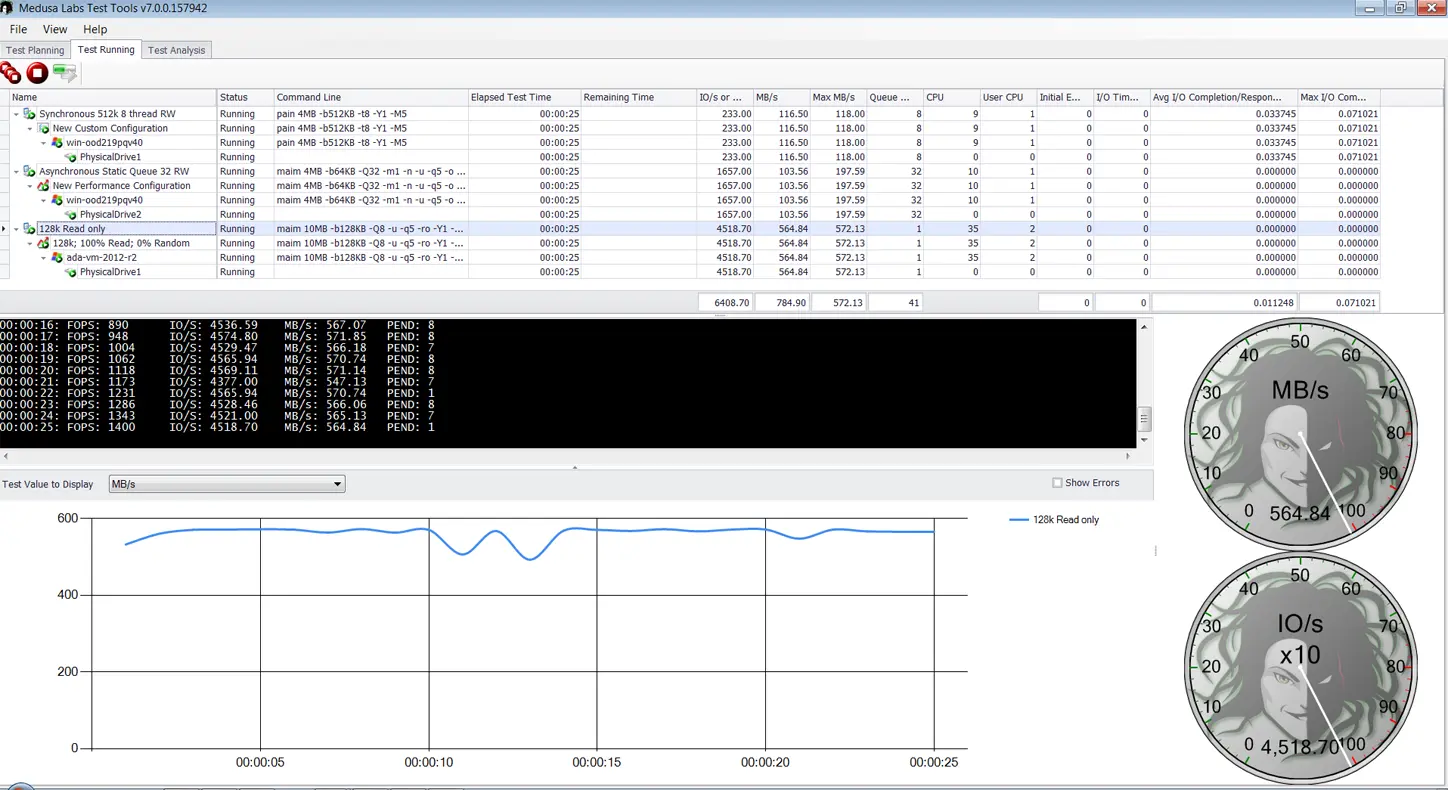
Test cases, scripts and full test plans are created and managed from a single GUI, with remote management, auto-discovery of devices and remote upgrades across hundreds of clients and servers. MLTT can trigger VIAVI Xgig protocol analyzers with a unique data payload when a data anomaly is first detected, supporting root-cause analysis without having to reproduce the error.
Key Features
- Precise storage I/O and TCP or UDP traffic generation with full traffic flexibility and control
- Automatic triggering of Xgig protocol analyzers and advanced tracking of anomalies and errors
- Auto-discovery of devices and automation of remote testing across complex network topologies
- Configurable steady-state detection for SSD and NVMe benchmark testing
- Erase methods for ATA-, SCSI- and NVMe-attached devices to restore a factory-fresh state
- Format Unit commands supporting T10-PI types 0, 1, 2 and 3 and NVMe read/write
- Coordinated TCP burst mode to induce TCP incast conditions
- Sample test plans in the GUI
- Journal and verify logging of recent write operations for re-verification after power loss
- Configurable data compression entropy and de-duplication percentage data pattern
- Import of existing Iometer test configurations
- Configurable latency histogram and collection of SMART target statistics
- Full-duplex, low-overhead I/O engine for high-performance benchmarking
- Multicore testing with configurable thread CPU affinity
- Test library for TCP application simulation including Oracle, Exchange, HTTP and SIP Registration/Invite
- Virtual machine and virtual switch performance testing
- Advanced I/O workloads with per-load I/O size and bandwidth percentage
- SCSI passthrough modes for DIF and DIX testing with sector sizes such as 520 bytes
- I/O operation history tracing with optional payload logging
- Cross-platform support for Windows, Linux, Solaris and HP-UX with OS layer bypass
- Customizable results graphs
- Remote software upgrades of distributed systems from the GUI
Specifications
| Recommended processor |
2 GHz processor, or better
Recommended for optimal performance and full-duplex, wirespeed throughput with data-integrity checking; requirements vary with the architecture under test
|
|---|---|
| Recommended memory | at least 1 GB RAM |
| Multiprocessor support | Can take full advantage of multiple processors when available |
| Windows | x64 Windows 2003, 2008, 2012, 2016, 7, 8, 8.1, 10 |
|---|---|
| Linux | Linux; Linux on POWER; Linux ARM |
| Itanium | Windows and Linux for Itanium-based systems |
| Cross-platform support |
Windows, Linux, Solaris, and HP-UX
Linux I/O methods include full disk coverage and static queue depths
|
| Protocol-specific patterns |
Fibre Channel, FCoE, iSCSI, SATA, SAS, IDE, SCSI, RAID, USB, and Ethernet
MLTT is protocol agnostic but includes protocol-specific patterns for application-based testing
|
|---|
| T10-PI type 0 | disabled |
|---|---|
| T10-PI type 1 | read/write 10 or read/write 16 |
| T10-PI type 2 | read/write 32 |
| T10-PI type 3 | read/write 10 or read/write 16 |
| NVMe | NVMe Read/Write |
| License model |
Flexible and scalable licensing on a per-seat subscription basis
Installable on any system; the license determines the number of systems used concurrently; automated licensing management options supported
|
|---|
Specifications are taken from the manufacturer's documentation. See the datasheet for complete and current values.
Applications
- Unified SAN and LAN testing for converged networks
- Design validation and system bring-up of servers, switches, HBAs and CNAs
- Quality-assurance testing of storage equipment
- SSD, NVMe and all-flash array testing
- Data verification after unexpected initiator or target failure
- Compression and de-duplication testing
- Pre-release stress testing of storage systems
- Large-scale testing across hundreds of remote clients and servers
- Virtualization impact testing on server performance