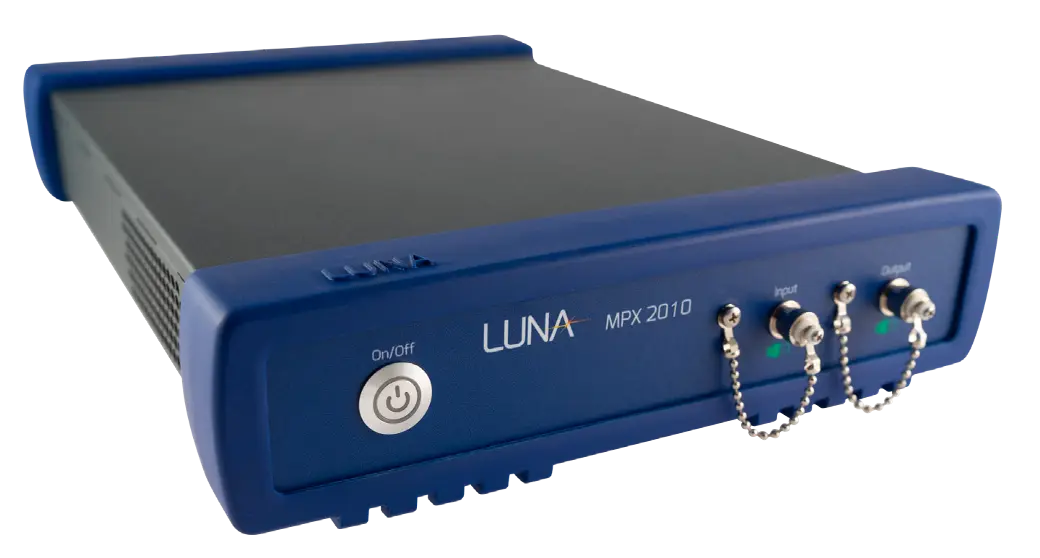
Luna MPX 2010 Multifunction Polarization Controller and Scrambler
All-fiber, lossless polarization controller and scrambler with polarization scrambling rates of up to 40,000 SOPs per second.
- Wavelength range
- 1260 to 1620 nm (typical 1550 nm)
- Wavelength range
- 980 to 1310 nm
- Power handling
- 0 to 1000 mW
- Insertion Loss (IL)
- 0.5 dB
Overview
The Luna MPX 2010 is a general-purpose, all-fiber, lossless polarization controller and scrambler designed for manufacturing test applications. It is built around the four-axis PolaRite III fiber-squeezer polarization controller, in which four piezoelectric actuator-driven fiber squeezers oriented at 0°-45°-0°-45° induce linear birefringence to change the state of polarization (SOP) of light passing through the fiber.
The all-fiber construction gives low insertion loss, polarization dependent loss and polarization mode dispersion. The standard version covers the O, C and L bands (1260-1620 nm) in a single unit and handles optical power up to 1 W. A second version covers 980-1310 nm.
Operating modes
Four polarization scrambling profiles are provided. Tornado scrambling traces a spiral around a static or rotating axis for a nearly uniform SOP variation rate. Rayleigh scrambling produces a continuous trace with a Rayleigh-distributed SOP variation rate, emulating SOP variation in a fiber link. Triangle scrambling produces a continuous trace with uniform sphere coverage for PDL measurement. Discrete scrambling covers the Poincaré sphere with random points at a uniform rate to randomize SOP and mitigate polarization sensitivity.
In SOP modulation mode, each control axis can be driven with sine, square or triangle waveforms of user-defined frequency and amplitude. Manual control sets the drive on each channel directly through the remote-control interface. An externally triggered scrambling mode generates a discrete random SOP for each trigger input pulse, for synchronization with other instruments such as in recirculating loop experiments.
Control and software
The instrument is controlled over USB 2.0 or Ethernet 100BASE-TX using SCPI commands, a C/C++ API or the PolaX PC GUI. The MPX 2010 replaces the legacy MPC-201 instrument.
Key Features
- Multiple operation modes
- Low IL, RL, PDL, PMD and activation loss (AL)
- Improved GUI software interface and communication speeds
- USB 2.0, Ethernet 100BASE-TX
- SCPI command, C/C++ API, PC GUI
- Trigger in/out
- Polarization scrambling speed of up to 40,000 SOPs/second
- Four scrambling profiles: Tornado, Rayleigh, Triangle and Discrete
- Externally triggered random SOP generation
- Handles optical power up to 1 Watt
- All-fiber design covering 1260-1620 nm in a single unit
- Replaces the legacy MPC-201 instrument
Specifications
|
Wavelength range
MPX 2010-1
|
1260 to 1620 nm (typical 1550 nm)
Min. 1260, typ. 1550, max. 1620
|
|---|---|
|
Wavelength range
MPX 2010-2
|
980 to 1310 nm |
| Power handling | 0 to 1000 mW |
| Insertion Loss (IL) |
0.5 dB
Max.; intrinsic without connectors < 0.1 dB
|
| Polarization Dependent Loss (PDL) |
0.05 dB
Max.; a low PDL/activation loss version (0.01 dB intrinsic) is available upon request for PDL measurement applications
|
| Polarization Mode Dispersion (PMD) |
0.1 ps
Max.
|
| Activation Loss (AL) |
0.05 dB
Max.; a low PDL/activation loss version (0.01 dB intrinsic) is available upon request
|
| Return Loss (RL) |
50 dB
Intrinsic without connectors > 65 dB
|
| Discrete random states | 0.00 to 40,000 points/s |
|---|---|
| Triangle | 0.00 to 4000 x 2π rad/s |
| Rayleigh rate distribution |
0.00 to 4000 rad/s
Mean of Rayleigh distribution
|
| Tornado (quasi-uniform rate distribution) | 0.00 to 4000 revolutions/s |
| Number of channels | 4 |
|---|---|
| Range | 0 – 4π each channel |
| Waveforms | Sine, Triangle, Square |
|---|---|
| Frequency |
0.00 to 2000 Hz
The user manual GUI section lists 0-1000 Hz; datasheet value shown
|
| Amplitude | 0 to 3π peak-to-peak |
| Input trigger | Random SOP per TTL trigger pulse, up to 40,000 points/s |
|---|
| Communication interfaces | USB 2.0, Ethernet 100BASE-TX |
|---|---|
| Remote control | SCPI command, C/C++ API, PC GUI |
| Trigger connectors | SMA |
| Output trigger | TTL pulse per SOP generated in discrete scrambling mode or TTL pulse per one period in Polarization modulation mode |
| Input trigger | One random SOP generated per TTL pulse received in trigger mode |
| Power supply | 100-240 VAC, 50 ~ 60 Hz, 65W maximum |
|---|---|
| Input/output triggers | TTL pulse, SMA connector |
| Communication interfaces | USB, Ethernet |
| Dimensions | 13.3 (L) x 9.5 (W) x 2.5 (H) inch |
|---|---|
| Operating temperature |
0 to 50 °C
Typical 25 °C
|
| Storage temperature |
-20 to 70 °C
Typical 25 °C
|
| Weight | 2.65 kg |
| Fiber type | Single Mode Fiber |
| Fiber input/output connectors | FC/APC |
| Specification conditions | Specifications apply for the standard 1260 to 1620nm version over a temperature range of 23 ± 5 °C with connectors |
|---|
Specifications are taken from the manufacturer's documentation. See the datasheet for complete and current values.
Applications
- SOP variation emulation
- Polarization scrambling
- Polarization sensitivity mitigation
- Circulating loop studies
- PDL/DOP measurements
- System polarization studies
- Manufacturing test
Included
- Power cable
- USB 2.0 A to B cable
- USB drive for GUI and documents
Options & Accessories
| Option | Description |
|---|---|
| MPX 2010-1-0-FC/APC | Multifunction Polarization Controller, 1260 nm to 1620 nm, FC/APC connectors — MPX 2010 main frame for C and L band |
| MPX 2010-1-L-FC/APC | Multifunction Polarization Controller, 1260 nm to 1620 nm, FC/APC connectors, low PDL/Activation loss — MPX 2010 main frame for C and L band |
| MPX 2010-2-0-FC/APC | Multifunction Polarization Controller, 980 nm to 1310 nm, FC/APC — MPX 2010 main frame for 1um band |
| MPX 2010-2-L-FC/APC | Multifunction Polarization Controller, 980 nm to 1310 nm, FC/APC connectors, low PDL/Activation loss — MPX 2010 main frame for 1um band |
| MPX 2010 GUI | MPX 2000 GUI Interface Software (PolaX) |
Documents & Resources
Related Products
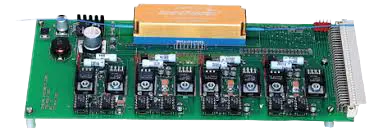
C-band all-fiber polarization scrambler module that randomizes output polarization to reach an output DOP below 5% averaged over 2 ms.
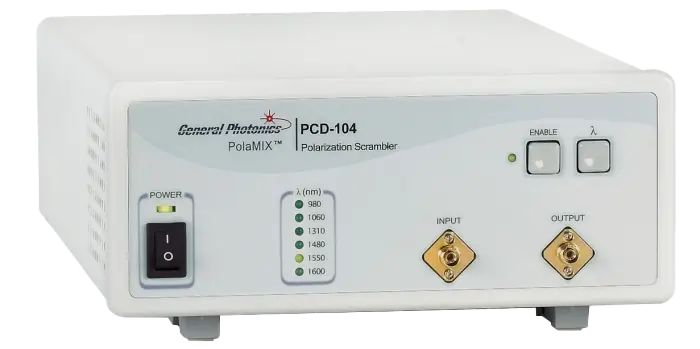
Benchtop all-fiber polarization scrambler that gives uniform Poincaré sphere coverage, with output DOP below 5% when averaged over 2 ms.
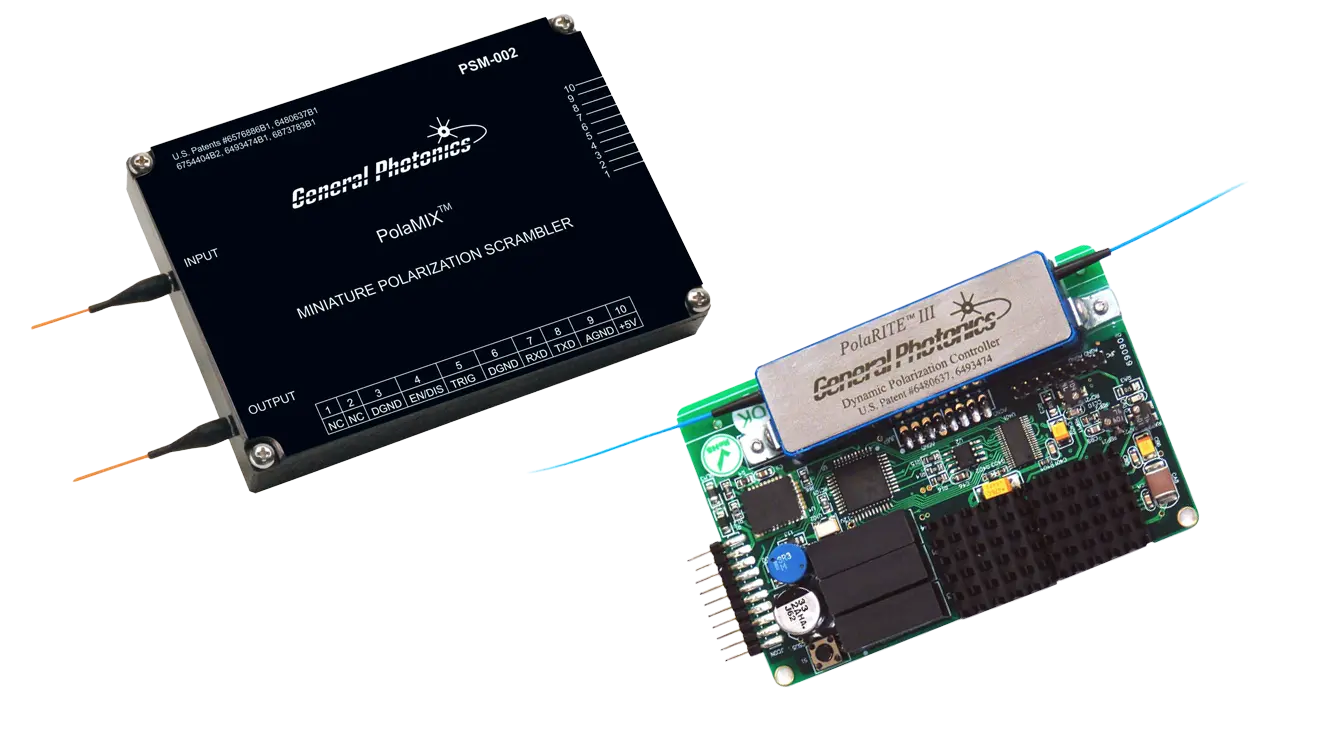
Miniature polarization scrambler module that generates discrete random polarization states at a user-selectable rate of 0.01 to 20,000 points/s.
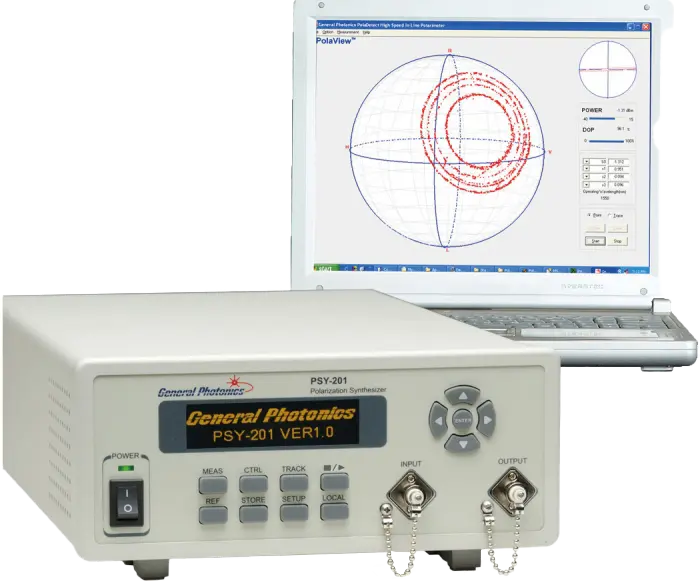
Deterministic polarization controller and polarimeter that generates, maintains, scrambles and analyzes any state of polarization regardless of input SOP.