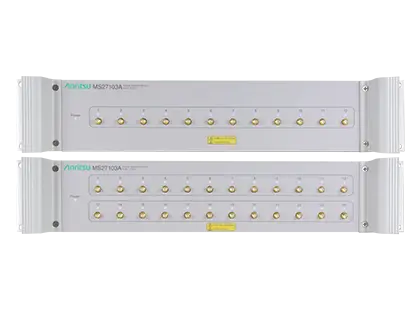
Anritsu MS27103A 12/24-Port Remote Spectrum Monitor, 9 kHz to 6 GHz
Rack-mountable 9 kHz to 6 GHz remote spectrum monitor with 12 RF inputs (24 optional) and sweep speeds up to 24 GHz/s.
- Frequency Range
- 9 kHz to 6 GHz
- Tuning Resolution
- 1 Hz
- Frequency Reference Accuracy
- ±1.5 ppm (25 °C ± 25 °C) ±1.0 ppm/year aging
- Frequency Reference Accuracy with GPS
- < ±50 ppb
Overview
The Anritsu MS27103A is a remote spectrum monitor for identifying and locating interfering signals. Typical uses are cellular base station (BTS) receive monitoring, distributed antenna systems (DAS) and satellite earth stations. Interference can come from illegal transmitters or from unintended sources such as intermodulation products, and it reduces network data capacity.
The instrument sits in a rack-mountable enclosure with 12 RF inputs as standard, or 24 with Option 424. A high-speed electronic switch moves between ports in approximately 300 ns, and the datasheet specifies more than 30 dB isolation between RF input ports. The standard configuration suits three-sector BTS architectures with multiple carriers per sector. The 24-port version suits six-sector sites or other applications that need many antennas and frequency bands.
The MS27103A sweeps at up to 24 GHz/s, so it can capture periodic, transient and short bursty signals. A 20 MHz instantaneous FFT bandwidth allows wideband real-time captures for later post-processing. IQ data can be recorded in block mode or streamed. A save-on-event function records spectrum measurements only when user-set thresholds are exceeded.
Remote operation and communication
An integrated web server lets users control the monitor and view traces and spectrograms from Chrome or Firefox on any device. Communication runs over Gigabit Ethernet using DHCP, a static IP address (default 10.0.0.2) or DNS. Users can also write their own control programs with SCPI commands. IQ samples are time-stamped by the built-in GPS receiver, which supports time difference of arrival (TDOA) geolocation. For remote deployments, the monitor provides a watchdog timer, remote firmware updates and a protected "Golden" firmware image for automatic recovery.
Software
Vision software (options 400 and 401) runs on a Windows PC. Vision Monitor records spectrum data, keeps a searchable spectrum history database, raises alarms and sends email alerts. Vision Locate geolocates interference or unlicensed signals using three or more monitors. With Option 128, IQ Signal Master MX280005A software can post-process captured IQ data.
Key Features
- 9 kHz to 6 GHz frequency range
- 12 RF IN ports as standard, 24 with Option 424, for use with multiple antennas
- Sweep speed up to 24 GHz/s
- 20 MHz instantaneous FFT bandwidth
- Integrated web server to view, control and conduct measurements via web browser (Chrome and Firefox supported)
- Remote firmware update capable
- Watchdog timer for long-term stability of remotely deployed monitors
- Linux operating system
- Low spurious signals for accurate signal discovery
- Low power consumption < 11 watts
- Integrated GPS receiver for monitoring location and time synchronization
- Gigabit Ethernet for high-speed transfers
- Measurements: occupied bandwidth and channel power
- Interference analysis: spectrogram and signal strength
- Dynamic range > 106 dB normalized to 1 Hz BW
- IQ block mode and streaming with time stamping for TDOA applications
- Remote control via SCPI commands
- 4 GB internal memory for storing files
- Save-on-event capture when user-set thresholds are violated
- Optional Vision software for automated spectrum measurements, alarms and geo-locating signal sources
Specifications
| Frequency Range |
9 kHz to 6 GHz
Tunable to 0 Hz
|
|---|---|
| Tuning Resolution | 1 Hz |
| Frequency Reference Accuracy | ±1.5 ppm (25 °C ± 25 °C) ±1.0 ppm/year aging |
| Frequency Reference Accuracy with GPS |
< ±50 ppb
GPS on
|
| Frequency Span | 10 Hz to 6 GHz |
| Sweep Speed, 10 kHz RBW |
5 GHz/s
Typical, full span FFT mode
|
| Sweep Speed, 30 kHz RBW |
12 GHz/s
Typical, full span FFT mode
|
| Sweep Speed, 3 MHz RBW |
24 GHz/s
Typical, full span FFT mode
|
| Resolution Bandwidth (RBW) |
10 Hz to 3 MHz in 1–3 sequence
–3 dB bandwidth
|
|---|---|
| Video Bandwidth (VBW) |
10 Hz to 3 MHz in 1–3 sequence
–3 dB bandwidth; auto or manually selectable
|
| Instantaneous FFT Bandwidth |
20 MHz
Datasheet highlights list 20 MHz IF bandwidth
|
| SSB Phase Noise @ 1 GHz, 10 kHz offset |
–98 dBc/Hz
Typical. Product page and flyers state –99 dBc/Hz; datasheet value used
|
|---|---|
| SSB Phase Noise @ 1 GHz, 100 kHz offset |
–98 dBc/Hz
Typical
|
| Dynamic Range |
> 106 dB
Typical; 2.4 GHz, 2/3 (TOI-DANL) in 1 Hz RBW
|
|---|---|
| Measurement Range | DANL to Maximum Continuous Input |
| Reference Level Range | –150 dBm to +30 dBm |
| Attenuator Range | 0 dB to 50 dB in 5 dB steps |
| Amplitude Units |
dBm, dBµV
Log scale modes
|
| Amplitude Accuracy, Port 1, 9 kHz to 5 GHz |
±2.5 dB
Attenuation ≤ 40 dB, preamp off for frequencies less than 100 kHz
|
| Amplitude Accuracy, Port 1, > 5 GHz to 6 GHz |
±3.0 dB
Attenuation ≤ 40 dB
|
| Amplitude Accuracy, Ports 2 to 12, 9 kHz to 5 GHz |
±3.0 dB
Typical
|
| Amplitude Accuracy, Ports 2 to 12, > 5 GHz to 6 GHz |
±3.5 dB
Typical
|
|
Amplitude Accuracy, Ports 13 to 24, 9 kHz to 5 GHz
MS27103A-0424
|
±3.0 dB
Typical
|
|
Amplitude Accuracy, Ports 13 to 24, > 5 GHz to 6 GHz
MS27103A-0424
|
±3.5 dB
Typical
|
| VSWR |
< 2.5:1
Typical
|
| DANL, preamp off, 10 MHz to 3.3 GHz |
–140 dBm
Port 1; typical –145 dBm; reference level –20 dBm; RBW normalized to 1 Hz, 0 dB attenuation
|
|---|---|
| DANL, preamp off, > 3.3 GHz to 4.1 GHz |
–133 dBm
Port 1; typical –138 dBm
|
| DANL, preamp off, > 4.1 GHz to 5 GHz |
–130 dBm
Port 1; typical –135 dBm
|
| DANL, preamp off, > 5 GHz to 6 GHz |
–115 dBm
Port 1; typical –123 dBm
|
| DANL, preamp on, 10 MHz to 3.3 GHz |
–157 dBm
Port 1; typical –160 dBm; reference level –50 dBm
|
| DANL, preamp on, > 3.3 GHz to 4.1 GHz |
–152 dBm
Port 1; typical –155 dBm
|
| DANL, preamp on, > 4.1 GHz to 5 GHz |
–148 dBm
Port 1; typical –152 dBm
|
| DANL, preamp on, > 5 GHz to 6 GHz |
–133 dBm
Port 1; typical –141 dBm. Other ports typical and within 1 dB of Port 1
|
| Residual Spurious, preamp off, 10 MHz to 4.5 GHz |
< –80 dBm
Typical; RF input terminated, 0 dB input attenuation
|
|---|---|
| Residual Spurious, preamp off, > 4.5 GHz to 6.0 GHz |
< –70 dBm
Typical; RF input terminated, 0 dB input attenuation
|
| Residual Spurious, preamp on, 10 MHz to 5.0 GHz |
< –95 dBm
Typical; RF input terminated, 0 dB input attenuation
|
| Residual Spurious, preamp on, 16 MHz to 18 MHz |
< –88 dBm
Typical
|
| Residual Spurious, preamp on, > 5.0 GHz to 6.0 GHz |
< –85 dBm
Typical
|
| Input-Related Spurious |
< –60 dBc
0 dB attenuation, –30 dBm input, carrier offset > 5 MHz
|
| Second Harmonic Distortion, 50 MHz |
–50 dBc
Typical; 0 dB attenuation, –30 dBm input
|
| Second Harmonic Distortion, > 50 MHz to 200 MHz |
< –60 dBc
0 dB attenuation, –30 dBm input
|
| Second Harmonic Distortion, > 200 MHz to 3000 MHz |
< –60 dBc
0 dB attenuation, –30 dBm input
|
| TOI, 800 MHz |
+7 dBm
Typical; preamp off, –20 dBm tones 100 kHz apart, 0 dB attenuation, reference level –20 dBm
|
|---|---|
| TOI, 2400 MHz |
+17 dBm
Typical
|
| TOI, 200 to 2200 MHz | +10 dBm |
| TOI, > 2.2 GHz to 5.0 GHz | +8 dBm |
| TOI, > 5.0 GHz to 6.0 GHz | +14 dBm |
| 100 MHz to 6 GHz, ≥ 10 dB attenuation |
+22 dBm, ±50 VDC
For lower frequencies, derate maximum continuous input by 4 dB per decade
|
|---|---|
| 300 kHz to 6 GHz, < 10 dB attenuation |
+10 dBm, ±50 VDC
For lower frequencies, derate maximum continuous input by 4 dB per decade
|
| 9 kHz to 6 GHz, preamp on | –10 dBm, ±50 VDC |
| Data Types, I/Q time series | 8, 10, 16 or 24 bit resolution |
|---|---|
| Data Types, spectrum trace | 100 to 4000 points |
| Data Transfer Modes | I/Q time series or spectrum trace in streaming or block mode |
| I/Q Data Streaming Rate | Gapless on 100Base-T network, Up to 2.6 MHz signal bandwidth |
| I/Q Data Time Stamp Resolution |
8.7 ns
GPS time-stamped; product page states less than 9 ns
|
| Antenna Port Isolation, ≤ 3 GHz |
> 40 dB
Typical
|
| Antenna Port Isolation, > 3 GHz |
> 30 dB
Typical
|
| I/Q Recording Time, 20 MHz signal bandwidth |
1.3 s (24 bits), 2.5 s (16 bits), 3.8 s (10 bits), 5 s (8 bits)
Typical; output data rate 76.25 / 3 MSPS
|
| I/Q Recording Time, 1.33 kHz signal bandwidth |
4.66 h (24 bits), 9.33 h (16 bits), 13.99 h (10 bits), 18.65 h (8 bits)
Typical; output data rate 76.25 / 40000 MSPS
|
| Internal Trace/Setup Memory | 4 GB internal memory available for storing files |
|---|---|
| Mode Switching | Automatically stores/recalls most recently used setup parameters in the mode |
| Power Consumption | < 11 watts |
| Warranty | Standard three-year warranty |
| RF In | 12 SMA(f) ports, 50 Ω |
|---|---|
|
RF In (optional)
MS27103A-0424
|
24 SMA(f) ports, 50 Ω |
| External Power |
11 W, ±20 VDC to ±70 VDC 2-pin spade/lug
Standard
|
|
External Power (Option 110)
MS27103A-0110
|
110/220 VAC
Option 110 replaces screw terminal with 3-pin AC line receptacle
|
| Ethernet | One RJ45 connector for Gbit LAN, 2nd port optional for daisy chain |
| USB | Two USB Type A connectors |
| External Reference In | 10 MHz, +10 dBm max, +5 VDC max, BNC(f) |
| GPS | SMA(f) |
| European Union EMC | 2014/30/EU, EN 61326:2013, CISPR 11/EN 55011, IEC/EN 61000-4-2/3/4/5/6/8/11 |
|---|---|
| Low Voltage Directive | 2014/35/EU |
| Safety | EN 61010-1:2010 |
| RoHS Directive |
2011/65/EU
Applies to instruments with CE marking placed on the market after July 22, 2017
|
| Australia and New Zealand | RCM AS/NZS 4417:2012 |
| South Korea | KCC-REM-A21-0004 |
| Canada | ICES-1(A)/NMB-1(A) |
| Environmental Standard | MIL-PRF-28800F Class 3 |
|---|---|
| Operating Temperature Range |
0 ºC to 50 ºC
Quick Fact Sheet states -40 ºC to 50 ºC; datasheet value used
|
| Storage Temperature Range | –40 ºC to 71 ºC |
| Maximum Relative Humidity | 95 % RH at 30 ºC, non-condensing |
| Vibration, Sinusoidal | 5 Hz to 55 Hz |
| Vibration, Random | 10 Hz to 500 Hz |
| Half Sine Shock | 30 g |
| Altitude | 4600 meters, operating and non-operating |
| ESD, RF Input Pin | Withstands up to ±4 kV |
| Size | 480 mm x 90 mm x 300 mm (18.9 in x 3.5 in x 11.8 in) |
|---|---|
| Weight, 12-port | 3.9 kg (8.9 lb) |
|
Weight, 24-port
MS27103A-0424
|
4.5 kg (9.9 lb) |
Specifications are taken from the manufacturer's documentation. See the datasheet for complete and current values.
Applications
- Cellular operators monitoring their spectrum at the BTS
- DAS interference monitoring
- White space monitoring with multiple antennas
- Satellite earth station uplink and downlink monitoring
- Network interference monitoring
- Geo-location of interference signals
- Spectrum occupancy measurements
- Spectrum activity history and threshold alarms
- Applications requiring multiple directional antennas
Included
- 2000-1528-R Magnet Mount GPS antenna, SMA(m) with 5 m (16.4 ft) cable, requires 5 VDC
- 2000-1371-R Ethernet Cable, 2.13 m (7 ft)
Options & Accessories
| Option | Description |
|---|---|
| MS27103A-0706 | 9 kHz to 6 GHz Frequency Range — Required frequency option |
| MS27103A-0128 | Vector Signal Analysis Enabled — Use with MX280005A |
| MS27103A-0424 | Expands Input Ports to 24 SMA(f) |
| MS27103A-0110 | 110/220 VAC Power Supply input |
| MS27103A-0412 | Two Ethernet Ports |
| MS27103A-0400 | Vision Monitor Enabled |
| MS27103A-0401 | Vision Locate Enabled — Requires Option 400 |
| MS27103A-0407 | Vision High-Speed Port Scanner Enabled |
| MS27103A-0486 | Vision Coverage Mapping — Requires Option 407 |
| 760-287-R | Large Transit Case with Wheels and Handle — Quick Fact Sheet lists part number 760-285-R |
Documents & Resources
Related Products
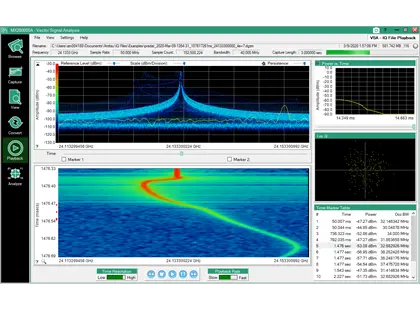
PC software for capturing, playing back, converting and analyzing IQ data from Anritsu spectrum analyzers, with modulation quality measurements.
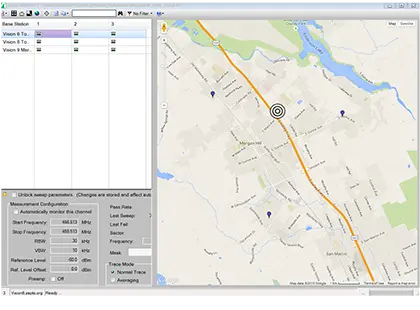
Windows PC software for monitoring, identifying and geo-locating interference signals with networks of Anritsu remote spectrum monitors.